
You’re Quietly Eroding Performance (and the Algorithm Knows It)**
If you’ve ever hovered over the “Create new RSA” button and thought, “One more won’t hurt,” you’re in familiar territory.
Initially, that instinct feels logical. After all, more ads should mean more testing, more combinations, and more chances to win auctions. For years—especially during the ETA era—that mindset worked.
However, once Responsive Search Ads became the default, something subtle but damaging began to happen.
Despite adding more RSAs, CTR plateaued, the learning phase dragged on, and optimizations felt strangely sluggish. Meanwhile, performance didn’t collapse—but it didn’t climb either.
Eventually, the realization hit:
RSAs don’t scale the way traditional ads did.
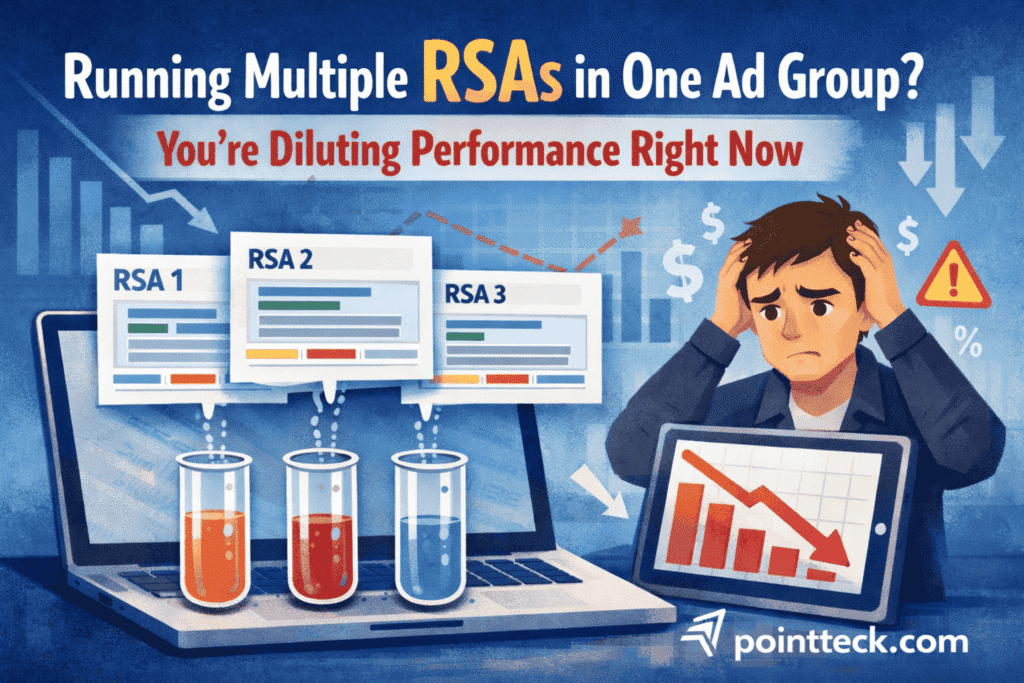
And by stacking multiple RSAs inside one ad group, the system wasn’t learning faster—it was learning slower.
This article explains why running multiple RSAs in a single ad group dilutes performance, how Google Ads machine learning interprets that setup, and what modern advertisers should do instead.
Why RSAs Behave Differently Than You Expect
Responsive Search Ads aren’t just flexible text units. Instead, they are machine-learning frameworks designed to assemble headlines and descriptions dynamically based on search intent, context, and predicted relevance.
Because of that, RSAs rely heavily on clean, concentrated data signals.
Less Noise, Stronger Machine Learning Signals
Unlike static ads, RSAs test combinations, not versions. Therefore, the algorithm must observe enough impressions and clicks to determine which messaging patterns actually drive engagement.
However, when you run multiple RSAs in one ad group, several things happen at once:
- Impression volume is split across ads
- Click data becomes thinly distributed
- Learning confidence is delayed
- Optimization signals become blurred
As a result, each additional RSA reduces the statistical clarity the system needs to optimize efficiently—especially in ad groups with moderate or low traffic.
Why This Is a Serious Optimization Problem
Machine learning thrives on repetition and consistency. Yet, when too many ads compete for limited data, the algorithm struggles to identify winning patterns.
Consequently, you often see:
- Prolonged learning phases
- Inconsistent ad delivery
- Slower ROAS stabilization
In short, the system isn’t underperforming—it’s under-informed.
Impression Dilution and Fragmented Learning Loops
Another hidden cost of multiple RSAs is impression fragmentation.
Let’s break it down.
What’s Actually Happening in the Auction
Imagine this setup:
- One ad group
- Three RSAs
- Each RSA with different headline logic
Now, for every auction, Google must decide which RSA deserves exposure, before it even assembles the best headline combination.
Therefore, impressions scatter.
The Compounding Effect
Instead of one RSA accumulating enough data to self-optimize quickly, you get:
- Three partially trained ads
- No clear performance leader
- Hesitation in impression scaling
As a consequence, the entire ad group underperforms—not because the ads are bad, but because none of them are sufficiently trained.
When RSAs Compete Against Themselves
RSAs don’t just compete with competitors. Ironically, they often compete internally.
Algorithmic Self-Competition Explained
From Google’s perspective, multiple RSAs in one ad group represent parallel prediction models fighting for the same auctions.
This leads to:
- Impression cannibalization
- Suppressed high-performing combinations
- Shared data pools that drag performance averages down
In effect, you’re forcing the system to optimize three models when it could be perfecting one.
Google’s Quiet Preference for Fewer, Stronger RSAs
Officially, Google allows up to three enabled RSAs per ad group.
However, allowance does not equal recommendation.
What Platform Behavior Tells Us
In practice, Google Ads performs best when:
- Variation exists inside the RSA
- Not between multiple RSAs
Modern search AI prioritizes data density over data volume. Therefore, one well-structured RSA often outperforms several average ones.
From ETA Thinking to RSA Reality
Historically, advertisers relied on manual A/B testing.
Why Multiple Ads Worked in the ETA Era
- Ads were static
- Performance was directly comparable
- Humans chose winners
Why That Logic Breaks with RSAs
- RSAs self-test combinations
- Headlines adapt dynamically
- Manual comparisons lose meaning
As a result, applying ETA-era habits to RSA campaigns introduces inefficiency rather than improvement.
What You Should Do Instead
The High-Performance RSA Framework
✅ Start with one primary RSA per ad group
- Use all 15 headlines and 4 descriptions
- Mix benefits, emotional triggers, offers, and intent-based phrases
- Allow Google’s system to rotate internally
When a Second RSA Makes Sense
- High impression volume
- Radically different messaging theme
- Clear monitoring and pruning strategy
⚠️ Avoid more than two RSAs unless
- The ad group is highly segmented
- Traffic volume supports parallel learning
- Messaging intent is fundamentally different (e.g., brand vs promotion)
Structure Always Beats Volume
If you feel compelled to add more RSAs, pause.
Often, that urge signals structural inefficiencies, such as:
- Overloaded ad groups
- Mixed search intent keywords
- Messaging conflicts within the same auction pool
A Smarter Long-Term Approach
- Segment keywords by intent
- Build tighter ad groups
- Align one RSA per intent cluster
As a result, relevance improves, Quality Score rises, and machine learning accelerates.
Why This Insight Matters More Than Ever
Running multiple RSAs in one ad group doesn’t break campaigns—but it quietly caps their potential.
Over time, it:
- Dilutes impression and click signals
- Slows algorithmic optimization
- Creates ambiguous performance data
- Weakens ad relevance in auctions
The strongest Google Ads accounts today aren’t louder—they’re cleaner, tighter, and structurally intentional.
Frequently Asked Questions
Q1: Is running multiple RSAs in one ad group bad?
A. Not always. However, in most cases, it slows learning and dilutes performance unless traffic volume is very high.
Q2: How many RSAs should I run per ad group?
A. For most advertisers, one primary RSA is optimal. Add a second only with a clear testing purpose.
Q3: Does Google prefer one RSA per ad group?
A. While not stated explicitly, Google’s machine learning behavior consistently favors fewer, better-trained ads.
Q4: Can multiple RSAs hurt Quality Score?
A. Indirectly, yes. Fragmented learning can reduce relevance signals, impacting expected CTR and ad relevance.