In today’s hyper-competitive digital ecosystem, Google Ads still stands as a dominant force for generating website traffic. Yet, paradoxically, many brands experience a deeply unsettling pattern: steady clicks, zero conversions. On the surface, campaigns look “active.” However, beneath that activity lies wasted ad spend, bruised confidence, and shrinking margins.
In essence, paying for attention is easy. Converting that attention into revenue is the real challenge.
This in-depth guide unpacks why Google Ads clicks but no sales happen, explores the psychological and technical layers behind the issue, and explains how expert PPC companies systematically fix the problem. More importantly, it clarifies why understanding this gap is crucial for long-term growth.
Why “Google Ads Clicks but No Sales” Is a Critical Wake-Up Signal
At first glance, clicks feel like progress. However, clicks alone do not equal business success.
In reality, clicks indicate curiosity, whereas sales represent trust and intent fulfilled. Therefore, when traffic flows but conversions stall, it signals a misalignment somewhere along the customer journey.
For performance-driven businesses, this problem directly impacts:
- Cost per acquisition (CPA)
- Return on ad spend (ROAS)
- Marketing scalability
- Forecasting accuracy
Consequently, ignoring this issue can silently drain budgets while offering false optimism.
The Anatomy of a Click That Never Converts
When users click a Google Ad but leave without buying, several friction points may be at play. Often, it’s not a single flaw—but a chain reaction.
1. Ad Promise vs. Landing Page Reality (Intent Mismatch)
Most commonly, the ad sets expectations that the landing page fails to meet.
For example:
- The ad highlights a limited-time discount, but the page doesn’t mention it.
- The ad copy emphasizes speed or simplicity, yet the page is cluttered.
- The call-to-action changes tone or disappears entirely.
As a result, trust erodes within seconds.
Key takeaway: Message continuity between keyword → ad → landing page is non-negotiable for conversions.
2. Broad Targeting That Attracts the Wrong Crowd
Although higher traffic may feel encouraging, irrelevant traffic is expensive noise.
This often happens due to:
- Overly broad match keywords
- Ignoring search intent (informational vs. transactional)
- Weak audience segmentation
For instance, users searching “what is CRM software” are researching—not buying. Consequently, clicks increase while sales stagnate.
3. Low Ad Relevance and Quality Score Decay
Google’s Quality Score heavily influences who sees your ad and at what cost.
When relevance is low:
- CPC rises
- Ad positions weaken
- Ads appear to poorly matched searchers
Over time, this attracts curiosity clicks instead of buyer clicks—reducing conversion probability.
4. Landing Page UX and CRO Failures
Even with perfect targeting, poor user experience can kill conversions instantly.
Common issues include:
- Slow page speed
- Weak or confusing CTAs
- Mobile usability problems
- Missing trust signals (reviews, guarantees, security badges)
Since most clicks are mobile, even minor UX friction can cause massive drop-offs.
5. Pricing Shock or Weak Value Proposition
Sometimes, the ad works—but the offer doesn’t.
Users may click, evaluate, and then hesitate because:
- Pricing feels misaligned with perceived value
- Benefits are unclear
- Competitors appear more compelling
High bounce rates often reveal this silent objection.
6. Conversion Tracking and Attribution Blind Spots
Surprisingly, some “no sale” scenarios are measurement failures—not performance failures.
Issues often stem from:
- Broken conversion tags
- Improper GA4 configuration
- Missing eCommerce tracking
- Cross-domain attribution errors
In these cases, sales occur—but analytics never record them.
From Click Metrics to Customer Journeys: A Brief Historical Shift
 In the early PPC era, clicks and impressions dominated success metrics. Visibility was the goal because digital attention was scarce.
However, as digital marketing matured, marketers realized something pivotal:
👉 Clicks are easy to buy. Conversions are earned.
This transition marked the rise of:
- Conversion rate optimization (CRO)
- Attribution modeling
- Customer lifetime value (LTV)
- Funnel-based marketing
Today, clicks without sales are not just disappointing—they’re diagnostic warnings.
Why Google Ads Clicks but No Sales Happen (Deep Analysis)
Search Intent Fragmentation
Not all searches signal readiness to buy. Intent typically falls into:
- Informational
- Navigational
- Transactional
Without intent-based keyword structuring, campaigns bleed budget on curiosity clicks.
User Context and Funnel Awareness
Additionally, user readiness varies:
- First-time visitors seek clarity
- Returning users seek reassurance
- High-intent users seek speed
Therefore, a single generic landing page rarely converts everyone equally.
Funnel Breaks and Micro-Conversion Gaps
Often, the issue isn’t the ad—it’s the path.
Broken funnels may include:
- Too many form fields
- Unclear next steps
- No urgency or incentive
- Poor checkout flow
Fixing even one friction point can dramatically lift conversion rates.
Psychological Resistance and Trust Deficits
Humans hesitate before buying.
They compare.
They doubt.
They delay.
Hence, elements like testimonials, social proof, guarantees, and authority markers reduce friction and build emotional safety.
How PPC Companies Help Solve the “Clicks but No Sales” Problem

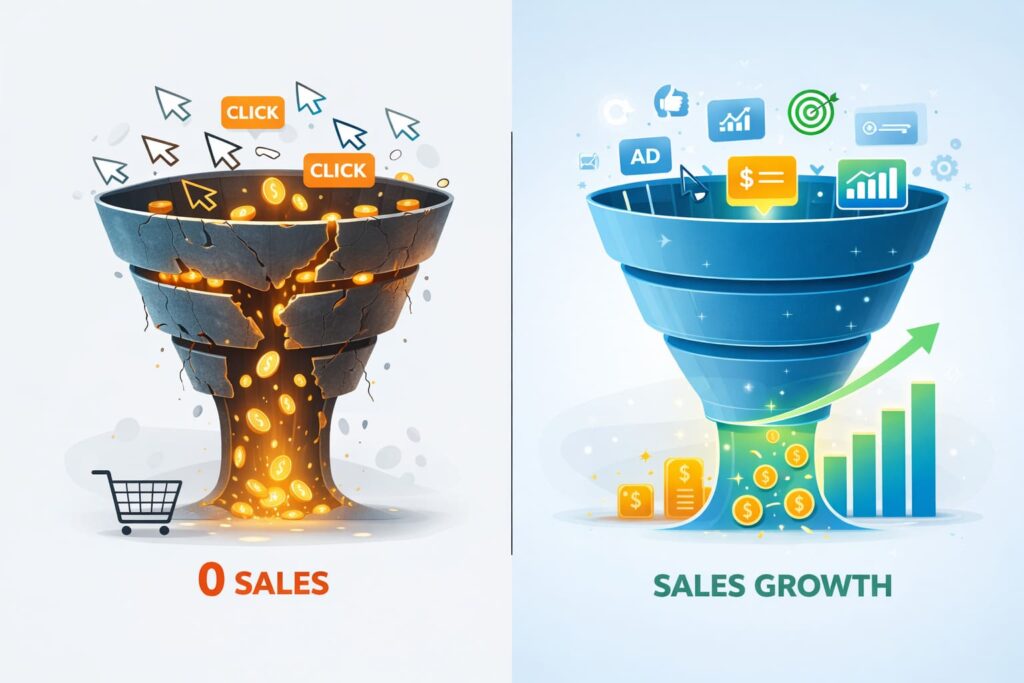
Professional PPC agencies don’t chase clicks—they engineer outcomes.
Strategic Keyword and Intent Mapping
They refine keyword intent to attract buyers, not browsers.
Precision Audience Segmentation
They leverage remarketing, in-market audiences, and behavioral signals.
Landing Page and CRO Optimization
They align messaging, improve UX, and remove conversion barriers.
Tracking, Analytics, and Attribution Audits
They ensure every lead and sale is correctly measured.
Competitive and Offer Intelligence
They analyze pricing, messaging, and positioning gaps.
Continuous Testing and Optimization
They A/B test ads, landing pages, bids, and audiences relentlessly.
Key Takeaways for Sustainable Growth
- Clicks are attention—not revenue
- Intent alignment drives conversions
- Landing pages sell, not ads alone
- Tracking accuracy is foundational
- Optimization is ongoing, not one-time
Ultimately, understanding why Google Ads clicks but no sales occur empowers businesses to shift from traffic chasing to revenue engineering.
Question & Answering about Google Ads Clicks but No Sales
Q1. Are Google Ads useless if I’m getting clicks but no sales?
Ans. No. It usually indicates misalignment—not failure. With proper optimization, performance can improve significantly.
Q2. How long should I test a Google Ads campaign before judging results?
Ans. Typically 2–4 weeks with sufficient data, depending on budget and traffic volume.
Q3. Can landing page changes really improve conversions?
Ans. Yes. Even small UX or copy improvements can increase conversion rates by 20–100%.
Q4. Do I need a PPC agency to fix this issue?
Ans. Not mandatory, but experienced PPC companies accelerate results and reduce costly trial-and-error.
Q5. What’s more important: traffic volume or traffic quality?
Ans. Traffic quality. Fewer high-intent clicks outperform thousands of low-intent ones.
Final Thought
When Google Ads generate clicks but no sales, the platform isn’t broken—the strategy is incomplete. By aligning intent, experience, psychology, and data, clicks can transform into customers—and frustration into scalable growth.