
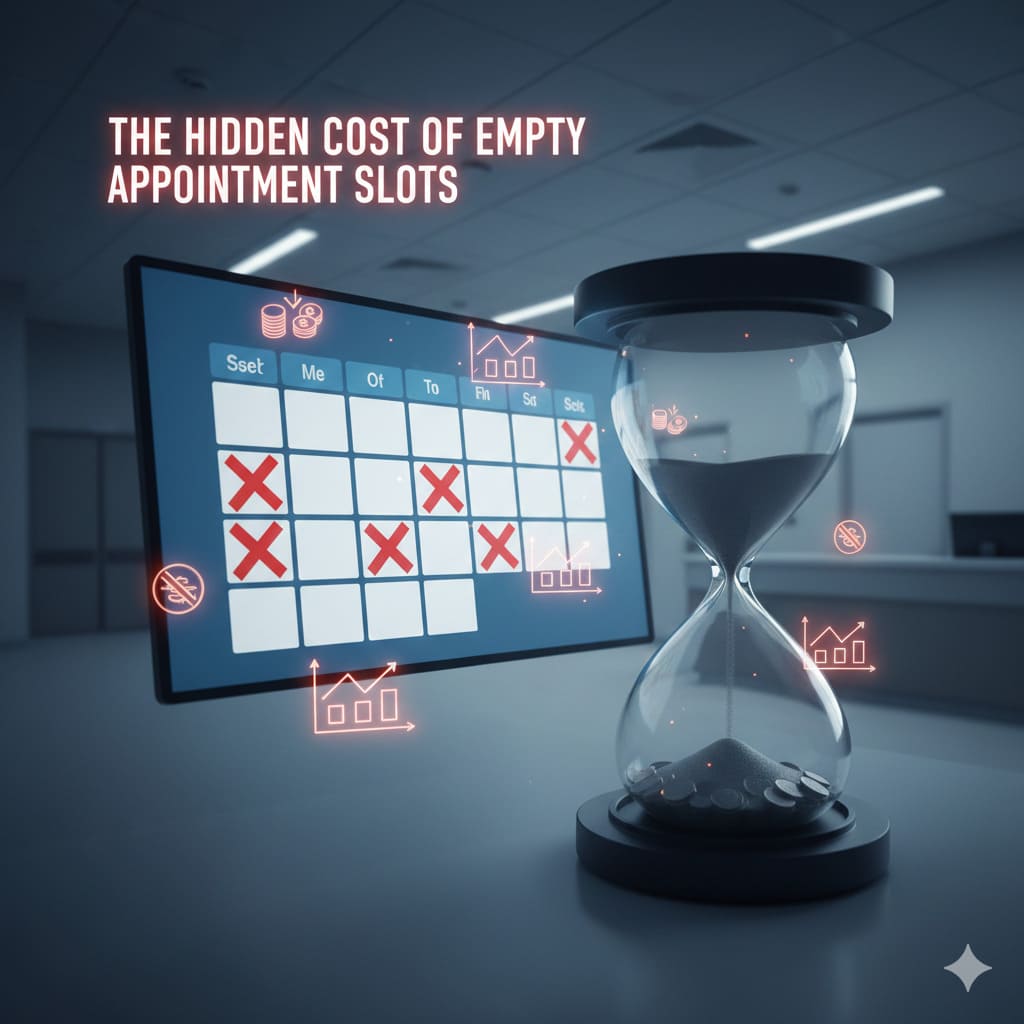
The Hidden Cost of the Empty Appointment Slot
A single unfilled appointment in a hospital system looks like a minor scheduling inconvenience. Multiplied across departments, weeks, and specialties, it becomes a structural revenue problem. According to research published in the American Journal of Managed Care, no-shows and last-minute cancellations cost the U.S. healthcare industry an estimated $150 billion annually — roughly $200 per unused appointment slot. For a mid-sized regional hospital running 500 outpatient appointments per day at even a 10% no-show rate, that translates to roughly $3.6 million in lost revenue every year, before factoring in the downstream costs of idle staff and underused equipment.
The challenge is no longer whether patients exist — Google Trends data consistently shows sustained growth in searches like “same-day doctor appointment,” “cardiologist near me,” and “walk-in MRI scan.” Patient demand is real and active. The gap is operational: how to connect that real-time demand to real-time clinical availability, especially when cancellations arrive with little notice and slots expire within hours.
This is precisely where Google Ads has evolved from a marketing channel into an operational lever — and why hospital administrators, patient access officers, and marketing directors increasingly need to understand it at a strategic level.
| STAT | The U.S. healthcare industry loses an estimated $150 billion annually to no-shows and last-minute cancellations. (American Journal of Managed Care) |
Why Appointment Utilization Is Now a Strategic Priority

Historically, hospitals relied on physician referrals, community reputation, offline advertising, and walk-in demand to fill their schedules. These channels remain relevant, but the patient journey has fundamentally shifted. A 2022 survey by Kyruus found that 68% of patients begin their search for a new provider using an online search engine — not a doctor recommendation. A separate report from Google and Compete Inc. found that 77% of patients use search engines prior to booking a healthcare appointment. Patients are no longer passive recipients of referrals. They are active, comparison-shopping consumers who expect availability transparency and frictionless scheduling.
From a financial and operational standpoint, the stakes are significant. A 2019 study in the Journal of General Internal Medicine estimated the average cost to a provider for a single no-show appointment at between $196 and $1,230, depending on specialty. Diagnostic imaging, which carries high fixed infrastructure costs, is particularly vulnerable: an idle MRI scanner costs a hospital money whether it runs 4 hours a day or 12. Every unfilled slot represents not just lost revenue, but a waste of clinical resources and a delay in care for patients who may be on a waiting list elsewhere in the system.
Why Google Ads Works for Hospitals When Other Channels Don’t
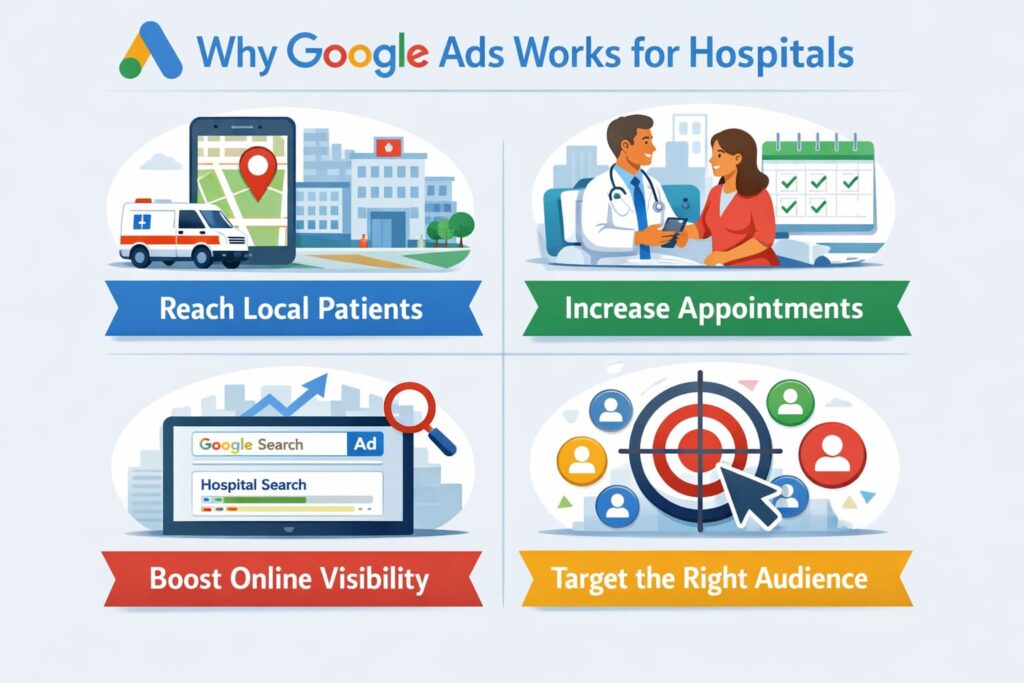
The fundamental difference between Google Ads and virtually every other marketing channel available to hospitals is this: Google Ads does not try to create demand. It captures demand that already exists.
When a patient searches “book cardiologist appointment near me” or “MRI scan available today,” they are not browsing. They are expressing active clinical intent, often with urgency. No billboard, TV spot, or direct mail campaign can intercept a patient at that precise moment of readiness. Google Ads can. This distinction — intent-based versus interruption-based advertising — explains why healthcare-specific Google Ads campaigns consistently outperform traditional channels on cost-per-acquisition metrics. There is no persuasion required. The patient has already decided to seek care. The only question is where they will go.
How Google Ads Helps Dentists Attract More Patients
PPC for Dentists: Why It’s Crucial for Your Practice
Geographic and Service-Line Precision
Unlike broad brand campaigns, Google Ads allows hospitals to target specific ZIP codes or geographic radii, individual departments or service lines, and specific procedures or appointment types. This precision transforms Google Ads from a marketing tool into a capacity management instrument. A hospital experiencing low utilization in its orthopedic surgery pre-op clinic on Tuesday mornings can run targeted ads for exactly that slot type, in the surrounding catchment area, with a landing page that shows real-time availability. No other paid channel offers this level of operational alignment.
Speed, Flexibility, and Cancellation Recovery
SEO campaigns take months to build. Traditional media requires advance purchase and cannot be adjusted once placed. Google Ads campaigns can be launched within hours, paused instantly, and adjusted daily — or hourly — in response to scheduling changes. For hospital scheduling teams dealing with last-minute cancellations, this responsiveness is operationally valuable in a way that no other marketing channel matches. A cancellation received at 8 a.m. can trigger an ad adjustment by 9 a.m. that begins filling the slot the same day.
Structuring Google Ads for Appointment Fill Rate, Not Just Clicks

Hospitals that succeed with Google Ads treat campaigns as a patient access system rather than an advertising program. The distinction shapes every decision, from keyword selection to landing page design.
Keyword Strategy: Intent Over Volume
Effective healthcare campaigns prioritize appointment-based and symptom-to-service keywords with local modifiers — terms like “orthopedic surgeon accepting new patients [city]” or “CT scan appointment this week” rather than broad terms like “hospital” or “healthcare.” High-volume keywords attract unqualified traffic and drive up cost-per-click without generating bookings. The goal is not maximum impressions but maximum booking-qualified clicks, and that requires narrower, more intentional keyword targeting.
Ad Messaging That Earns Trust Before the Click
Healthcare advertising operates in a high-trust environment. Patients making clinical decisions need to feel confident before they click, not just after they arrive on a landing page. Effective hospital ads combine a direct call-to-action (“Book Today,” “Same-Day Appointments Available”) with trust signals that matter in healthcare contexts: board certification, hospital affiliation, insurance acceptance, and accreditation. Vague claims like “expert care” or “compassionate providers” add noise without building confidence. Specific, verifiable credentials do.
Conversion Path Design: Removing Friction Between Ad and Appointment
An ad that generates a click but not a booking is expensive waste. Every Google Ads campaign for appointment filling should route patients to a dedicated landing page that eliminates barriers to scheduling: direct online booking or click-to-call for urgent services, minimal form fields, mobile optimization (over 60% of healthcare searches occur on mobile, per Google Health data), clear service and insurance information above the fold, and real-time or near-real-time availability display where technically feasible. Each additional step between ad click and confirmed appointment reduces conversion rate. The benchmark for well-optimized healthcare landing pages is a conversion rate of 8–15% — far above the industry-wide average of 3–4%.
Case Study: Recovering Lost Imaging Revenue at a Regional Hospital Network
| CONTEXT | The following case study describes a regional multi-specialty hospital network in the Mid-Atlantic U.S., operating four campuses with a combined diagnostic imaging volume of approximately 18,000 scans per quarter prior to intervention. |
The Challenge
The network’s imaging department was running at 76% utilization against a target of 95% — a gap largely driven by short-notice cancellations (averaging 48 cancellations per week across locations) and uneven weekday demand, with Mondays and Fridays consistently underbooked. Because imaging infrastructure costs are largely fixed, each idle scanner slot represented direct margin erosion. The scheduling team was manually calling waitlisted patients to fill gaps, a process that was both labor-intensive and unreliable: by the time a call reached a patient, the slot was often too soon for them to accommodate.
Objective
Increase imaging appointment utilization by at least 20% within 90 days without adding staff, equipment, or expanding hours. The target was to use demand that already existed in the market but was not being effectively captured.
Strategy
The hospital’s marketing team, working with an external Google Ads partner specializing in healthcare, designed service-specific campaigns for MRI and CT scans with geo-targeting set to a 15-mile radius around each campus. Ad copy led with availability signals — “Next-Available MRI Appointments,” “Same-Week CT Scan Scheduling” — and linked to dedicated landing pages built for each campus, featuring direct online booking integrated with the scheduling system. Weekly sync meetings between the marketing team and scheduling coordinators allowed campaign settings to reflect actual slot availability in near-real-time. Bid adjustments were made to increase ad spend on underbooked days (Mondays, Fridays) and reduce spend on days already approaching capacity.
Results (90 Days)
Imaging utilization increased from 76% to 94% — a 24% improvement against the baseline. Cost per booked scan through the Google Ads channel was 40% lower than the network’s historical cost-per-acquisition through traditional outreach. The scheduling team’s manual callback burden dropped significantly, freeing coordinator time for other patient access functions. Patient wait times across the imaging system remained stable, confirming that the campaign filled genuinely underutilized capacity rather than creating overload.
| KEY INSIGHT | Success came not from high ad spend, but from tight operational alignment: campaigns reflected actual availability, spoke to active patient intent, and routed directly to frictionless booking. The technology was straightforward. The discipline was the differentiator. |
Evaluating Whether to Build In-House or Partner With a Specialist
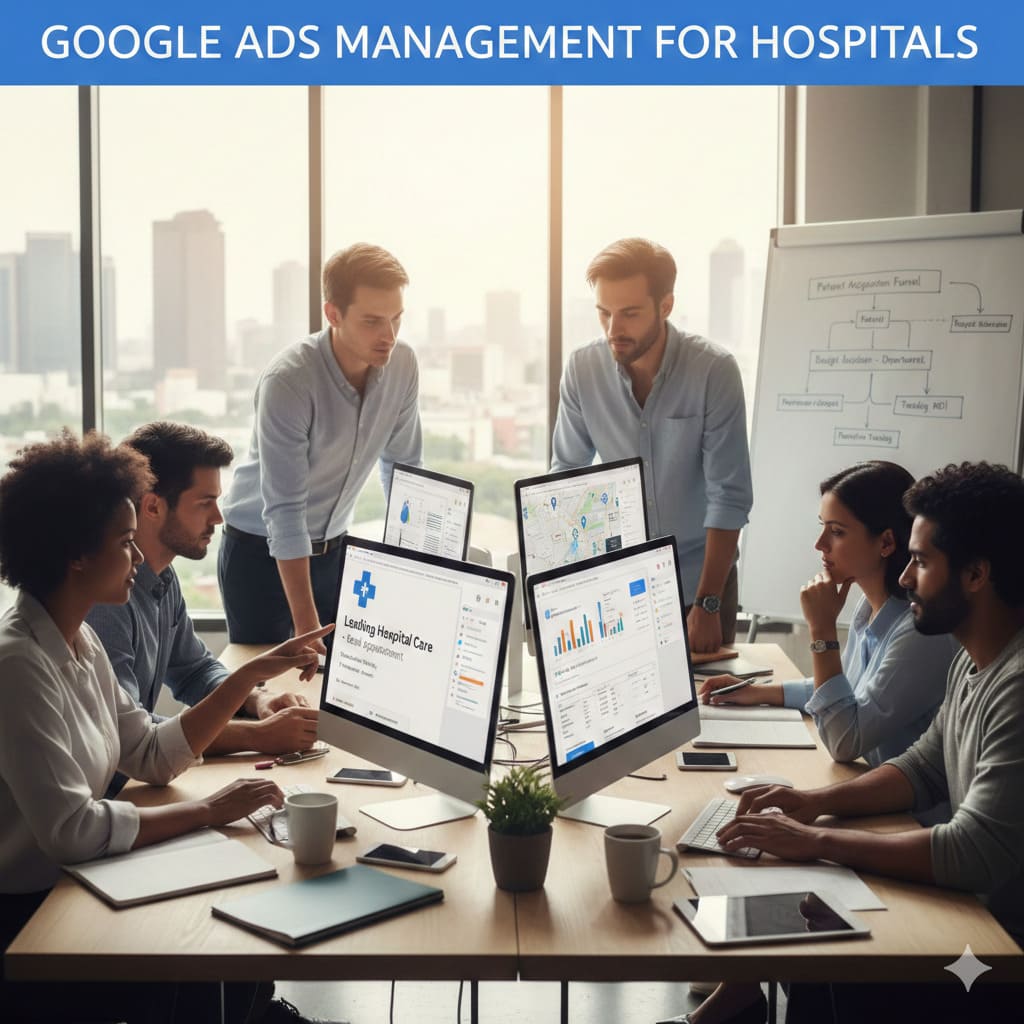 Hospitals face a genuine choice when implementing Google Ads at an operational level: manage campaigns internally with existing marketing staff, or engage a specialized external partner. Neither approach is universally correct, but the decision should be made against clear criteria rather than cost alone.
Internal teams offer advantages in institutional knowledge and scheduling system access — both important for the operational alignment that makes these campaigns effective. The limitation is specialization: healthcare Google Ads operates in a competitive bidding environment with regulatory complexity (HIPAA-adjacent advertising restrictions, platform healthcare policies, and patient privacy requirements) that rewards deep, domain-specific expertise. A generalist marketing team managing Google Ads alongside five other responsibilities will typically underperform a specialized operator running campaigns for hospitals full-time.
When evaluating any approach — internal or external — hospitals should look for the following capabilities:
- Capacity-aware campaign planning that adjusts to real scheduling data, not static monthly budgets
- Healthcare-compliant ad copy and landing page practices that satisfy platform policies and protect patient information
- Conversion tracking tied to actual appointments booked, not just clicks or calls
- Executive reporting that connects campaign spend to utilization improvement and revenue impact by department
- Demonstrated experience with healthcare clients, with reference cases showing measurable utilization outcomes
Hospitals that have achieved the strongest results — including the case study above — have typically built a hybrid model: internal scheduling and operational knowledge combined with external technical execution and continuous optimization. The key accountability metric is cost per scheduled appointment, not cost per click.
Compliance Considerations: What Healthcare Advertisers Must Get Right
Healthcare advertising on Google operates within a layered compliance environment that catches many hospitals off guard. Understanding the key requirements is essential before launching any campaign.
Google’s Healthcare and Medicines Policy
Google maintains specific policies for healthcare and pharmaceutical advertisers. Hospitals advertising in the United States generally do not face the same pre-certification requirements as pharmaceutical companies, but they are subject to restrictions on claims: ads must not be misleading about outcomes, must accurately reflect the services offered, and must not exploit patient vulnerability. Ads that promise specific medical outcomes (“Heal faster,” “Pain-free surgery”) violate platform policies and risk ad disapproval or account suspension.
HIPAA and Remarketing
One of the most significant compliance risks in healthcare digital advertising is remarketing — serving ads to users based on prior website behavior. If a hospital’s website collects data in a way that could identify users who visited specific clinical pages (e.g., oncology, mental health, HIV treatment), that data may constitute protected health information (PHI) under HIPAA. The HHS Office for Civil Rights has issued guidance indicating that tracking technologies on hospital websites can trigger HIPAA obligations when PHI is transmitted to third parties, including ad platforms. Hospitals should work with legal and compliance teams to audit their website tracking setup before launching remarketing campaigns, and should default to contextual or geographic targeting rather than behavior-based remarketing for sensitive service lines.
Landing Pages and Patient Privacy
Online scheduling forms and call tracking tools used in Google Ads campaigns must be implemented in a HIPAA-compliant manner. Any call recording or transcription capability must include patient notice. Form submissions that include health information must route through secure, compliant infrastructure. These are not theoretical risks — OCR enforcement actions related to web tracking in healthcare have increased significantly since 2022, and several major hospital systems have faced substantial settlements as a result.
The takeaway for hospital leadership is not that Google Ads is too risky to use, but that compliance must be built into campaign architecture from the start, not retrofitted after launch. Properly structured campaigns operate without compliance exposure. The risk is in underprepared execution.
FAQ: Google Ads for Filling Hospital Appointment Slots
Why is Google Ads more effective than traditional healthcare advertising for appointment filling?
Because it captures active patient intent rather than passive attention. Patients searching for care have already decided to seek treatment — the only question is where. A 2021 Google Health report found that 5% of all Google searches are health-related, representing billions of monthly queries. Traditional channels like TV or print reach audiences who may not be in a care-seeking mindset. Google Ads reaches patients at the precise moment they are ready to book, which is why healthcare Google Ads campaigns consistently achieve lower cost-per-acquisition than comparable traditional spend.
Can Google Ads help fill slots created by last-minute cancellations?
Yes, and this is one of its most operationally underutilized applications. Because campaigns can be adjusted within hours, a scheduling team that receives a wave of morning cancellations can trigger an ad adjustment by mid-morning that promotes same-day availability. Hospitals that have integrated their Google Ads campaigns with scheduling system workflows report meaningful same-day fill rates on what would otherwise be lost appointment revenue. The technical lift is modest; the operational discipline to execute it consistently is the harder part.
Which hospital departments benefit most from Google Ads?
Departments with appointment-based workflows and strong patient-initiated demand see the strongest results: diagnostic imaging (MRI, CT, ultrasound), cardiology, orthopedics, dermatology, women’s health, and urgent care. Procedural departments where patients can self-refer or respond to a symptom — rather than requiring a specialist referral chain — are best positioned to convert Google Ads traffic into confirmed appointments.
Is Google Ads compliant with HIPAA and healthcare advertising regulations?
Yes, when properly structured — but compliance is not automatic and requires deliberate architecture. The key risk areas are remarketing (which can implicate PHI), tracking pixels on clinical pages, and call recording. Ad copy must avoid misleading outcome claims per Google’s Healthcare and Medicines Policy. Hospitals should involve legal and compliance teams in campaign setup, particularly for sensitive service lines, and should audit website tracking infrastructure before launching remarketing. Well-built campaigns operate without material compliance risk. Underprepared ones do not.
How do hospitals measure campaign success beyond clicks?
The primary metrics for appointment-focused campaigns are cost per scheduled appointment (not cost per click), appointment attendance rate, utilization improvement by service line, and revenue attribution per department. Hospitals with more sophisticated analytics infrastructure integrate Google Ads data directly with scheduling systems to track the full patient journey from search query to completed visit. This attribution model allows leadership to evaluate Google Ads as a revenue investment rather than a marketing expense line.
Does increasing demand through Google Ads risk overloading the system?
Not when campaigns are built with capacity awareness. The goal is not to maximize volume indiscriminately but to redistribute existing market demand toward underutilized slots and service lines. Campaigns aligned with actual scheduling data fill gaps without creating overload. The hospital in the case study above ran at 94% imaging utilization — a high-performance level — without extending hours or adding staff, because demand was directed at genuine capacity rather than added on top of existing load.
How long before results are visible?
Initial directional results — increased click-to-call volume, online booking activity, appointment inquiry traffic — are typically visible within the first two to three weeks. Stable, optimized performance reflecting full campaign maturity develops within 60–90 days as bid strategies optimize, quality scores improve, and operational workflows between marketing and scheduling teams tighten. Hospitals should evaluate campaigns against a 90-day performance window, not a 30-day one.
Should hospitals manage Google Ads internally or use a specialized agency?
The decision should be made against capability, not just cost. Internal teams offer institutional knowledge and scheduling system proximity. Specialized PPC agencies offer domain expertise in healthcare advertising compliance, competitive bid management, and conversion optimization. Hospitals with dedicated digital marketing staff experienced in paid search can build effective in-house programs with proper training and tooling. Hospitals without that foundation typically see faster results and lower wasted spend through external partnership. The critical factor in either model is operational integration: campaigns must be connected to real scheduling data to perform at the level described in this article.
A Final Thought for Hospital Decision-Makers
The hospitals that will gain the most from Google Ads are not necessarily those with the largest budgets. They are the ones that treat it as an operational system rather than a marketing add-on — that connect campaigns to scheduling data, align ad spend to genuine capacity, and measure success in appointments filled rather than impressions served.
The core insight is deceptively simple: patients who are actively searching for care will go somewhere. Google Ads determines whether that somewhere is your hospital or a competitor’s. In a market where margins are tightening and patient expectations for frictionless access are rising, that determination is worth taking seriously.
Empty appointment slots are a solvable problem. The tools exist. The patient demand exists. The gap is execution.