
The real estate industry has become increasingly dependent on digital visibility. Most buyers and sellers now begin their journey online, researching neighborhoods, property values, market conditions, and real estate professionals before making contact. For realtors, being visible when prospects search locally is no longer optional. It is a core business requirement.
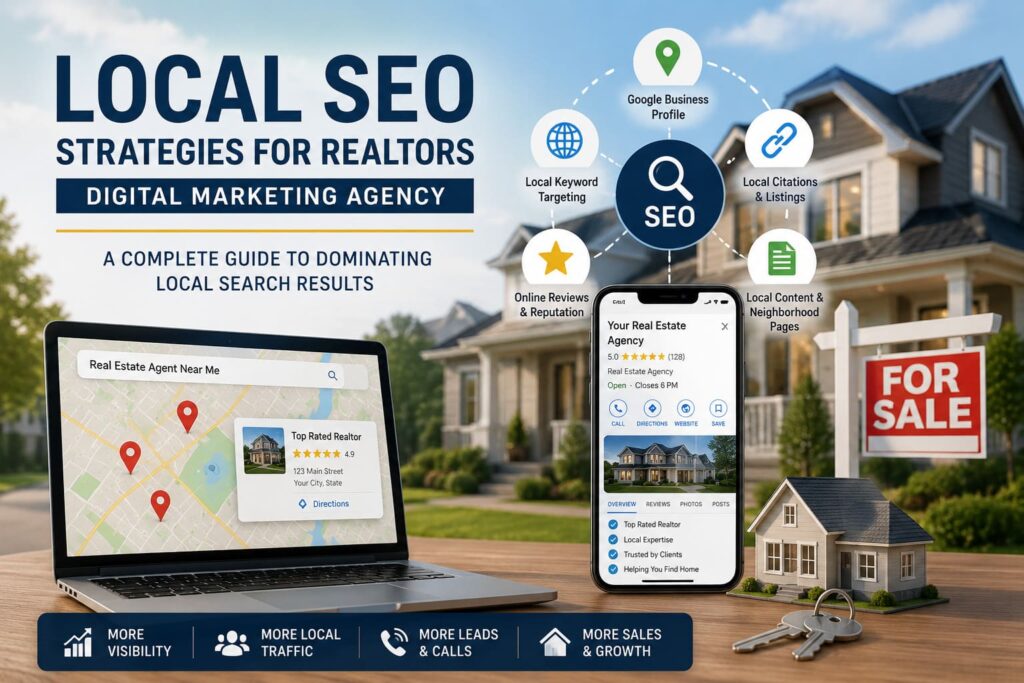
Local SEO strategies for Realtors Digital Marketing Agency services focus on helping agents and brokerages appear in local search results, Google Maps listings, and neighborhood-specific searches. Unlike traditional SEO, local SEO emphasizes geographic relevance, community authority, and location-based user intent.
This guide explores the most important local SEO factors for real estate professionals, including Google Business Profile optimization, local keyword targeting, citation management, review generation, neighborhood landing pages, competitive analysis, and advanced growth frameworks.
What Is Local SEO for Real Estate Agents?
Local SEO is the process of improving a business’s visibility in geographically targeted search results. For real estate professionals, this means appearing when potential clients search for terms such as “realtor near me,” “homes for sale in [city],” or “best real estate agent in [neighborhood].”
The goal is not simply to generate traffic but to attract highly qualified local prospects who are actively searching for real estate services. Because real estate transactions are location-driven, local SEO often produces higher-quality leads than broader digital marketing tactics.
Why Local SEO Matters More Than Ever
Consumer behavior has changed dramatically. Buyers increasingly rely on search engines to compare agents, evaluate neighborhoods, and understand local market conditions. Mobile searches have accelerated this trend because users often search while visiting neighborhoods or attending open houses.
Local SEO helps realtors build visibility at the exact moment prospects are making decisions. Appearing consistently across local search results, maps, reviews, and neighborhood content creates trust long before a direct conversation takes place.
Industry Data and Statistics
Research across the real estate industry consistently shows that online search plays a major role in home buying and selling decisions. Most buyers use online resources during their property search, and local search results frequently influence which agents they contact.
Google Business Profile listings often receive significant engagement through phone calls, website visits, and direction requests. Local search traffic also tends to convert at a higher rate because users are actively seeking services within a specific geographic area.
These trends highlight why local SEO should be viewed as a long-term investment rather than a short-term tactic.
Understanding Google’s Local Ranking Factors

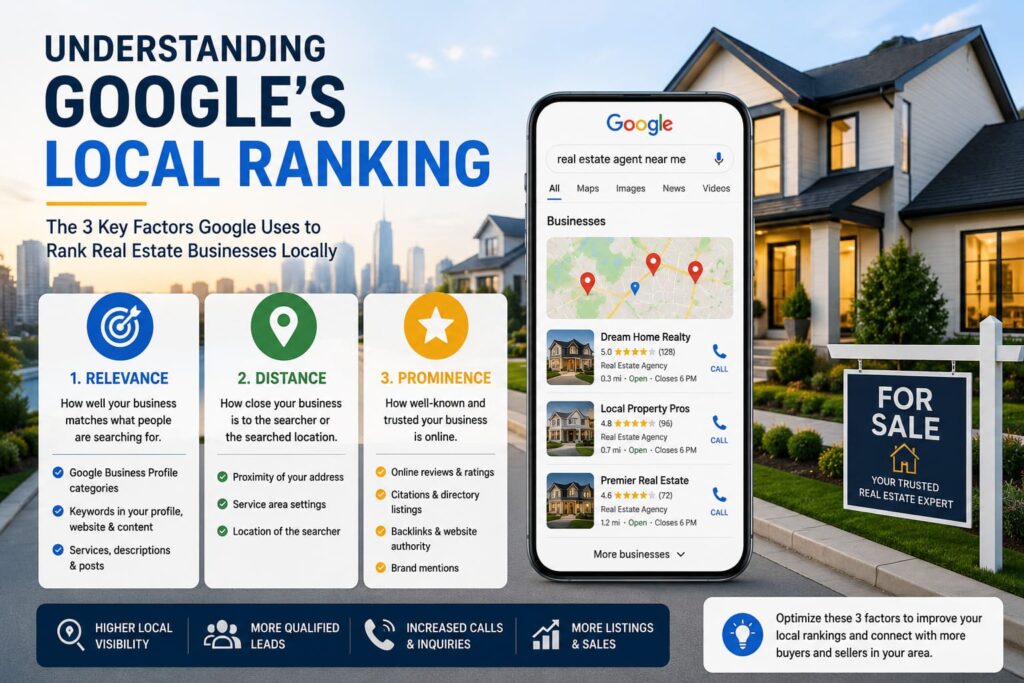
Google primarily evaluates relevance, distance, and prominence.
Relevance measures how closely a business matches the user’s search intent. Distance evaluates geographic proximity to the search location. Prominence reflects overall authority, trust, and recognition across the web.
Successful realtor SEO campaigns optimize all three factors simultaneously. Strong content improves relevance, neighborhood targeting improves geographic alignment, and reviews, citations, and backlinks strengthen prominence.
Google Business Profile Optimization
Google Business Profile is often the foundation of local SEO. For many users, it serves as the first interaction with a realtor.
Optimization should include accurate business information, service areas, office hours, business categories, professional descriptions, high-quality photos, and regular updates. Realtors should publish posts about listings, market reports, community events, and industry insights.
Review management is equally important. Positive reviews influence rankings and conversion rates, while professional responses demonstrate responsiveness and credibility.
The challenge is that profile optimization requires ongoing management. Businesses that treat their profile as a living asset often outperform competitors who update it only occasionally.
Local Keyword Targeting Strategies
Keyword targeting should reflect how people search for real estate services.
City-level keywords may include terms such as “real estate agent in Dallas” or “homes for sale in Miami.” Neighborhood-level keywords focus on more specific geographic areas and often have lower competition and stronger intent.
Long-tail keywords such as “best realtor for first-time homebuyers in Austin” can generate highly qualified traffic. Successful campaigns balance broad visibility with hyperlocal targeting.
Keyword research should also consider buyer intent, seller intent, investor intent, and relocation intent. Different audiences search differently, and content should reflect those differences.
Competitive SEO Analysis
Top-ranking realtor websites often share common characteristics. They maintain complete Google Business Profiles, generate consistent reviews, build local citations, earn community backlinks, and publish neighborhood-focused content.
Many successful competitors invest heavily in local authority rather than relying solely on listing pages. They publish market updates, relocation guides, school district information, community resources, and neighborhood spotlights.
A competitive analysis should evaluate content depth, review volume, backlink profiles, local citations, and user experience. Understanding why competitors rank can reveal opportunities for differentiation and growth.
Citation Management and Local Authority Building
Citations are online references that include a business name, address, and phone number. Consistency across directories helps search engines verify legitimacy and improve trust signals.
Important citation sources may include local directories, business associations, chamber of commerce websites, and real estate-specific platforms.
Common issues include duplicate listings, outdated contact information, and inconsistent business details. Regular citation audits help maintain accuracy and strengthen local authority.
Neighborhood-Specific Landing Pages
Neighborhood landing pages are among the most effective local SEO assets for realtors. These pages target hyperlocal searches and demonstrate community expertise.
A high-quality neighborhood page should include housing market trends, property types, pricing information, schools, transportation options, amenities, attractions, and frequently asked questions.
Many agencies make the mistake of creating thin location pages with minimal differentiation. Effective neighborhood pages provide unique value, local insights, and regularly updated information.
Although these pages require significant effort to create and maintain, they often deliver strong long-term SEO results.
Review Management and Reputation Building
Reviews influence both rankings and conversions. Prospective clients frequently compare reviews before selecting an agent.
A structured review strategy should encourage satisfied clients to share feedback after successful transactions. Realtors should also respond thoughtfully to both positive and negative reviews.
Reputation management extends beyond review collection. It includes monitoring brand mentions, addressing concerns professionally, and consistently delivering positive client experiences.
Local Link Building Strategies
Backlinks remain an important ranking factor. Local backlinks are particularly valuable because they reinforce geographic relevance.
Potential opportunities include local news publications, business organizations, sponsorships, community events, charitable initiatives, neighborhood blogs, and industry partnerships.
The goal is to build genuine community connections rather than pursue low-quality link schemes. Strong local links can improve both authority and referral traffic.
Advanced Local SEO Framework for Realtors
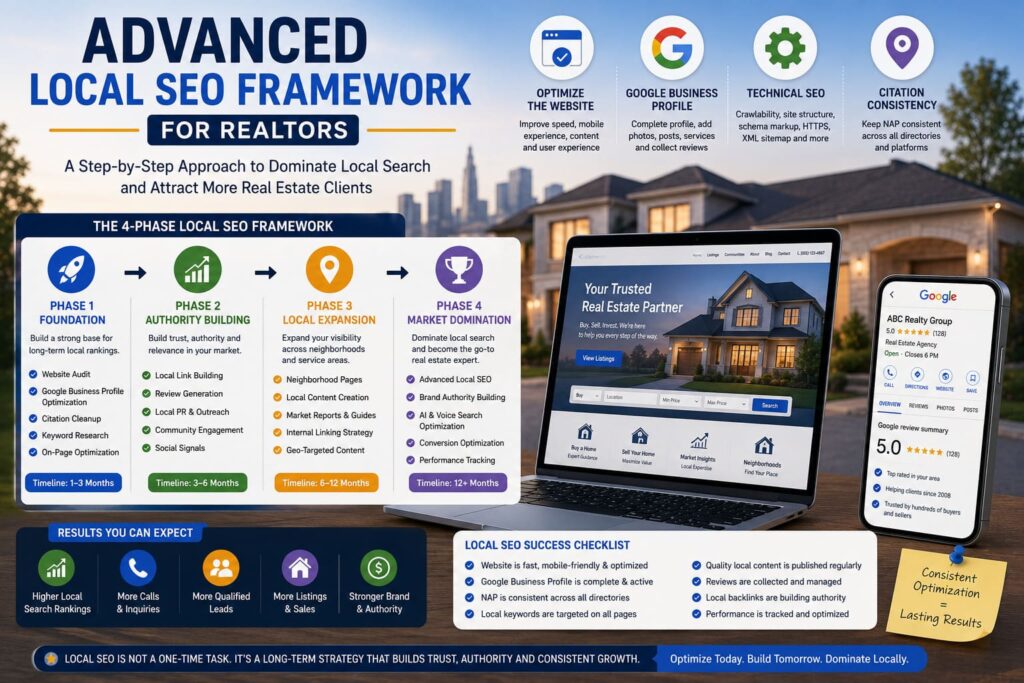
Phase 1: Foundation Building
Optimize the website, Google Business Profile, technical SEO, and citation consistency.
Phase 2: Authority Building
Generate reviews, acquire local backlinks, improve content quality, and strengthen brand visibility.
Phase 3: Market Expansion
Develop neighborhood pages, community guides, local resource hubs, and market reports.
Phase 4: Market Domination
Focus on thought leadership, AI-search visibility, advanced content clusters, and hyperlocal authority.
This phased approach helps realtors prioritize activities based on business maturity and available resources.
Common Realtor SEO Mistakes
Mistake 1: Ignoring Google Business Profile optimization.
Mistake 2: Targeting only broad city keywords while neglecting neighborhood opportunities.
Mistake 3: Creating thin location pages with little original value.
Mistake 4: Maintaining inconsistent citation information.
Mistake 5: Neglecting review generation and reputation management.
Mistake 6: Ignoring mobile usability and page speed.
Mistake 7: Focusing exclusively on rankings instead of lead generation and business outcomes.
Avoiding these mistakes can significantly improve long-term performance.
Measuring Local SEO Success
Key performance indicators include Google Business Profile engagement, local keyword rankings, organic traffic growth, lead submissions, phone calls, appointment requests, and closed transactions.
While rankings are important, business outcomes should remain the primary measurement. Effective local SEO ultimately supports revenue growth and market expansion.
Future Trends in Realtor Local SEO
Artificial intelligence is reshaping search behavior. Search engines increasingly prioritize authoritative, locally relevant content.
Voice search continues to grow, encouraging optimization around conversational queries. Hyperlocal content, personalized experiences, and community expertise are becoming more valuable.
Realtors who consistently invest in local authority and user-focused content will be better positioned to adapt to future search changes.
FAQ
How long does local SEO take for realtors?
Most campaigns begin showing meaningful improvements within three to six months, although highly competitive markets may require longer.
How many neighborhood pages should a realtor create?
Focus on quality rather than quantity. Prioritize neighborhoods where you actively serve clients.
Do citations still matter?
Yes. Consistent citations help search engines verify business legitimacy and improve local trust signals.
Is Google Business Profile enough?
No. It should be supported by content, reviews, citations, backlinks, and website optimization.
What is the most important ranking factor?
There is no single factor. Success comes from balancing relevance, distance, prominence, content quality, and authority signals.
Conclusion
Local SEO for real estate agents is one of the most effective long-term strategies for generating qualified leads and increasing market visibility. Success requires more than rankings alone. Realtors must optimize Google Business Profiles, target local keywords, manage citations, generate reviews, build community authority, and create valuable neighborhood-specific content.
Every strategy involves tradeoffs between time, budget, competition, and scalability. However, businesses that invest consistently in local relevance and user experience often build sustainable competitive advantages.
For a Realtors Digital Marketing Agency, the objective is not simply to increase traffic. It is to help real estate professionals become the trusted local authority that buyers and sellers choose when important decisions are being made.