
The real estate industry has become increasingly digital. Today’s buyers and sellers rarely begin their journey by contacting an agent directly. Instead, they search online, browse social media, compare local professionals, explore neighbourhoods, and research market conditions long before making a decision. This shift in consumer behavior has transformed how real estate professionals attract and convert clients. Social media advertising and lead generation for realtors services now play a critical role in helping agents build visibility, establish trust, and generate qualified opportunities in competitive markets.
However, generating leads is not simply a matter of running advertisements. Success requires a strategic combination of social media advertising, audience targeting, content marketing, retargeting, conversion tracking, and ongoing optimization. Understanding how these elements work together can help real estate professionals create a marketing system that delivers both immediate results and long-term growth.

What Is Social Media Advertising and Lead Generation for Realtors?
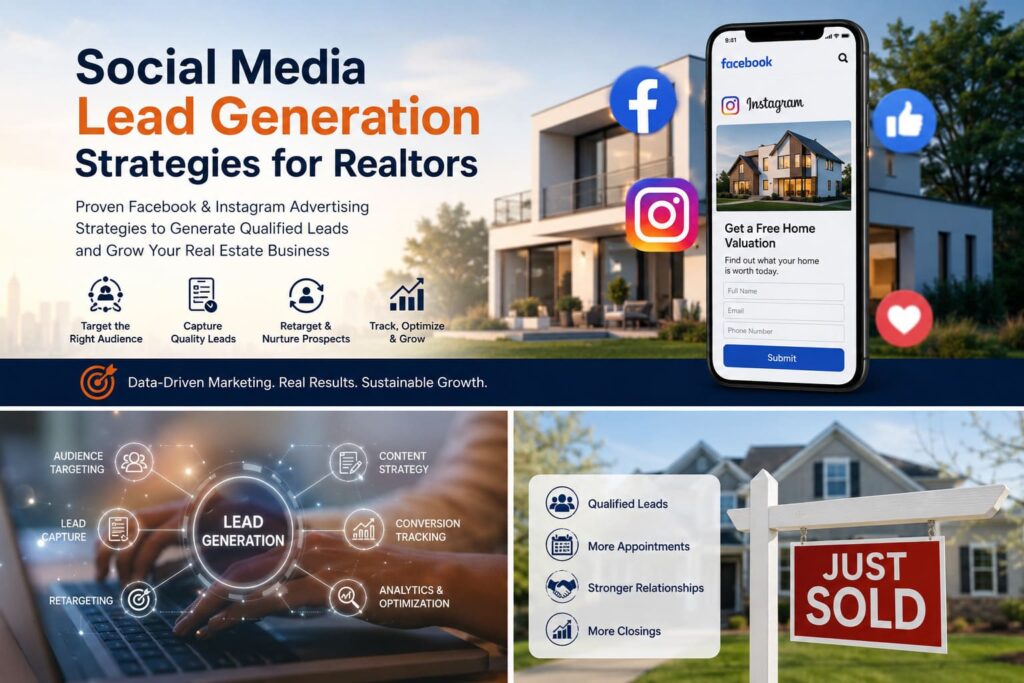
Social media advertising for real estate agents refers to the use of platforms such as Facebook and Instagram to reach potential buyers and sellers through targeted paid campaigns. Lead generation is the process of attracting interested prospects and encouraging them to share their contact information through forms, consultations, home valuation requests, property inquiries, or other conversion actions.
A successful real estate marketing strategy combines both. Social media advertising creates awareness and drives engagement, while lead generation systems convert that attention into measurable business opportunities. When executed correctly, these strategies help real estate professionals maintain a consistent pipeline of potential clients while strengthening their market presence.
Why Digital Lead Generation Matters for Real Estate Professionals
The traditional methods of acquiring clients—such as referrals, networking, and print advertising—still have value. However, relying solely on these channels can limit growth opportunities in today’s competitive market.
Digital lead generation offers several advantages:
- Consistent visibility among local audiences
- More precise audience targeting
- Better performance tracking and measurement
- Scalable marketing campaigns
- Opportunities to nurture prospects over time
- Improved return on advertising investment
At the same time, real estate professionals must balance lead quantity with lead quality. Generating hundreds of inquiries means little if those prospects are not genuinely interested in buying or selling property. The goal should always be attracting the right audience rather than simply maximizing lead volume.
Real Estate Digital Marketing by the Numbers
Consumer behavior continues to move online, making digital marketing increasingly important for real estate professionals. According to the National Association of REALTORS® (NAR), the vast majority of home buyers use the internet during their home search, making online visibility a critical component of any real estate marketing strategy.
Research from HubSpot also highlights the growing role of social media in modern marketing. What was once primarily a branding channel has evolved into a key platform for lead generation, audience engagement, and customer acquisition across industries.
These trends reinforce an important reality: today’s buyers and sellers expect to discover information, evaluate options, and engage with businesses through digital channels before making direct contact. For real estate professionals, maintaining a strong online presence is no longer optional—it is an essential part of remaining competitive.
The Role of Local SEO in a Real Estate Marketing Strategy
While social media advertising can generate immediate visibility and leads, Local SEO remains an important long-term marketing channel for real estate professionals. A strong local search presence helps agents appear when potential buyers and sellers search for real estate services within their target market, creating a steady source of organic inquiries over time. However, unlike paid advertising, Local SEO typically requires ongoing optimization and may take several months to produce significant results. For this reason, many successful real estate businesses combine Local SEO with social media advertising, using paid campaigns to drive short-term lead generation while building sustainable organic visibility for long-term growth. For a deeper understanding of optimization techniques and ranking factors, readers can explore a dedicated guide on Local SEO for real estate agents.
Social Media Advertising for Real Estate Agents
Why Social Media Has Become Essential
Facebook and Instagram have evolved into powerful advertising platforms that allow real estate professionals to reach highly specific audiences. Unlike traditional media, social platforms enable targeting based on geographic location, demographics, interests, online behavior, and lifestyle indicators.
This level of precision helps reduce wasted advertising spend while improving campaign performance. More importantly, social media platforms allow agents to connect with prospects at different stages of the buying and selling journey, making them highly effective tools for lead generation.
Facebook Lead Ads: Capturing Prospects Efficiently
What Are Facebook Lead Ads?
Facebook Lead Ads allow users to submit their contact information without leaving Facebook or Instagram. Instead of directing users to a separate landing page, the lead form opens directly within the platform, creating a smoother user experience and often improving conversion rates.
This format is particularly valuable for real estate professionals because many users browse social media on mobile devices and prefer quick, frictionless interactions.
Effective Lead Offers for Real Estate Campaigns
The success of a lead generation campaign often depends on the value offered to potential clients. Rather than immediately asking users to schedule a consultation, successful campaigns provide useful information or resources.
Popular lead magnets include:
- Free home valuation reports
- Neighborhood guides
- Property alerts
- Market updates
- First-time buyer resources
- Open house registrations
- Investment property insights
The stronger and more relevant the offer, the more likely users are to share their contact information.
Balancing Lead Volume and Lead Quality
One of the biggest challenges with Facebook Lead Ads is balancing quantity and quality. While the platform can generate a large number of inquiries, not every lead is ready to buy or sell.
Common challenges include:
- Incomplete information
- Low buying intent
- Delayed responses
- Unqualified prospects
This highlights the importance of audience targeting, lead qualification, and follow-up systems. A smaller number of highly qualified leads often delivers greater business value than a large volume of unqualified inquiries.
PointTeck Insight: Why More Leads Do Not Always Mean Better Results
One of the most common patterns we observe when managing real estate advertising campaigns is the assumption that lower cost-per-lead automatically means better performance. In practice, this is not always the case.
Many campaigns can generate a high volume of inexpensive leads, but a significant percentage may have limited intent to buy or sell. In contrast, campaigns that focus on audience quality, stronger qualification questions, and localized messaging often produce fewer leads but generate more meaningful conversations and appointments.
From our experience, the most successful real estate campaigns prioritize lead quality and conversion potential rather than focusing exclusively on lead volume metrics.
Common Mistakes Realtors Make with Facebook Lead Ads
Facebook Lead Ads can be highly effective, but several common mistakes often reduce performance.
Using Broad Audience Targeting
Targeting audiences that are too broad can generate large numbers of inquiries with little buying or selling intent.
Following Up Too Slowly
Lead quality often declines rapidly when follow-up is delayed. Prospects who submit a form typically engage with multiple agents, making response speed critical.
Focusing Only on Lead Volume
High lead counts do not necessarily translate into transactions. Tracking appointment rates and closed deals provides a more accurate measure of success.
Not Using Retargeting
Many prospects are not ready to act immediately. Without retargeting, agents may lose opportunities that could have converted later.
Lessons Learned from Real Estate Social Media Campaigns
Through managing social media campaigns for real estate professionals, several consistent trends have emerged.
First, neighborhood-focused content often generates higher engagement than listing-only content. Buyers are frequently interested in the lifestyle, schools, amenities, and overall community experience—not just the property itself.
Second, educational content tends to outperform direct promotional content over time. Market updates, buying guides, and local insights often build trust more effectively than constant sales messaging.
Third, retargeting audiences who have previously engaged with property content generally delivers stronger conversion rates than campaigns targeting entirely new audiences. Familiarity often plays a significant role in the decision-making process.
While every market is different, these observations highlight the importance of combining education, community-focused content, and strategic advertising within a broader lead generation strategy.
Ignoring Conversion Tracking
Running campaigns without proper tracking makes it difficult to identify which audiences, creatives, and offers are producing meaningful business results.
Instagram Advertising for Real Estate Agents
Instagram’s visual-first environment makes it particularly effective for real estate marketing. Properties, neighborhoods, and lifestyle content naturally align with the platform’s focus on imagery and video. For many agents, Instagram serves as both a lead generation channel and a branding platform, helping them build familiarity and trust with prospective clients.
Content Types That Perform Well on Instagram
Property Tours: Short-form video tours allow prospective buyers to explore homes before scheduling an in-person viewing.
Neighborhood Features: Showcasing local schools, restaurants, parks, and attractions helps prospects understand the lifestyle associated with a particular area.
Educational Content: Educational posts addressing common questions about buying, selling, financing, and market trends position agents as trusted advisors.
Client Success Stories: Testimonials and success stories provide social proof and demonstrate real-world results.
Balancing Branding and Direct Response Advertising
Many real estate professionals focus exclusively on listings and promotions. However, audiences are more likely to engage with accounts that provide value beyond property advertisements.
Brand-focused content helps:
- Build trust
- Increase recognition
- Establish authority
- Improve long-term engagement
Direct-response advertising, on the other hand, focuses on generating immediate inquiries.
The most effective strategy combines both approaches, using educational and community-focused content to build relationships while leveraging targeted campaigns to generate leads.
Examples of Effective Real Estate Social Media Campaigns
While every market is different, successful real estate campaigns often share common characteristics: strong targeting, valuable content, and clear calls to action.
Example 1: Home Valuation Campaign for Sellers
A residential real estate agent targeting homeowners may use Facebook Lead Ads to offer a free home valuation report. Rather than promoting services directly, the campaign focuses on helping homeowners understand their property’s current market value. The lead form collects basic contact information, while follow-up emails provide local market insights and opportunities to schedule a consultation. This approach often generates stronger engagement because it addresses a specific need rather than immediately requesting a sales conversation.
Example 2: Neighborhood Lifestyle Campaign
A realtor specializing in a specific community may create Instagram Reels and Facebook video ads showcasing local parks, schools, restaurants, and housing options. Instead of focusing solely on listings, the campaign highlights the lifestyle benefits of living in the area. Interested viewers are then retargeted with property listings and consultation offers, creating a more natural path from awareness to inquiry.
These examples illustrate how educational and community-focused content can often outperform purely promotional advertising.
Why Retargeting Is Essential in Real Estate Marketing
What Is Retargeting?
Retargeting involves showing advertisements to users who have previously interacted with a website, social media profile, property listing, video content, or lead form. These individuals have already demonstrated interest, making them significantly more likely to convert than completely new audiences.
Why Retargeting Improves Conversion Rates
Real estate transactions rarely happen immediately. Buyers and sellers often spend weeks or months researching options before contacting an agent. Retargeting helps maintain visibility throughout this decision-making process. By consistently appearing in front of interested prospects, agents can stay top-of-mind and increase the likelihood of future engagement.
Effective Retargeting Audiences
Successful retargeting campaigns often focus on:
Website Visitors: Users who viewed property listings, service pages, or neighborhood information.
Video Viewers: Individuals who watched property tours or educational videos.
Social Media Engagers: People who interacted with posts, advertisements, reels, or stories.
Lead Form Visitors: Prospects who opened but did not complete a lead form.
By tailoring messaging to each audience segment, agents can create more relevant and persuasive advertising experiences.
Building a Content Calendar for Consistent Lead Generation
Consistency is one of the most overlooked aspects of real estate marketing. Many agents post only when they have a new listing or significant announcement, leading to long periods of inactivity. A structured content calendar ensures regular engagement and helps maintain visibility with potential clients.
A Practical Weekly Content Framework
Monday: Market Insights: Share local market trends, housing data, and industry updates.
Tuesday: Property Showcase: Highlight active listings, recently sold properties, or virtual tours.
Wednesday: Educational Content: Answer common questions about buying, selling, financing, or investing.
Thursday: Community Features: Promote local events, businesses, schools, and neighborhood attractions.
Friday: Client Success Stories: Showcase testimonials, case studies, and client experiences.
Weekend: Open Houses and New Listings: Promote upcoming events and available properties.
Why Consistent Content Matters
Regular content creation helps:
- Increase audience engagement
- Strengthen brand recognition
- Support advertising campaigns
- Improve trust and credibility
- Generate long-term organic visibility
Over time, consistent content becomes a valuable asset that supports both lead generation and brand development.
Conversion Tracking Best Practices for Real Estate Marketing
What Is Conversion Tracking?
Conversion tracking measures the actions users take after interacting with advertising campaigns and marketing content.
Examples include:
- Lead form submissions
- Phone calls
- Appointment requests
- Property inquiries
- Home valuation requests
Without accurate tracking, it becomes difficult to determine which marketing efforts are producing actual business results.
Essential Conversion Tracking Tools
Meta Pixel: Tracks user actions resulting from Facebook and Instagram campaigns.
Google Analytics 4 (GA4): Provides insights into website behavior, user journeys, and conversion paths.
Google Tag Manager (GTM): Simplifies event implementation and ongoing tracking management.
CRM Integrations: Connect marketing activities to actual sales outcomes and client acquisition.
Common Conversion Tracking Mistakes
Many businesses focus solely on the number of leads generated. However, measuring lead quality and revenue impact is equally important.
Common mistakes include:
- Tracking only form submissions
- Ignoring phone call conversions
- Failing to connect CRM data
- Not measuring lead quality
- Optimizing for volume rather than outcomes
Accurate conversion tracking allows marketers to identify what is working and allocate budgets more effectively.
How PointTeck Approaches Social Media Lead Generation for Real Estate Agents
Generating leads in real estate requires more than simply running advertisements or posting listings online. Buyers and sellers often spend considerable time researching options before making contact, making it essential to stay visible throughout the entire decision-making process.
At PointTeck, social media lead generation strategies are designed to support every stage of this journey through a combination of audience targeting, content marketing, lead generation campaigns, retargeting, and conversion tracking. Rather than focusing solely on lead volume, the objective is to help agents attract prospects who are genuinely interested in buying or selling property.
Facebook and Instagram Lead Generation Campaigns
PointTeck develops targeted Facebook and Instagram campaigns built around offers that encourage meaningful engagement.
Examples include:
- Home valuation reports
- Market updates
- Property alerts
- Buyer and seller guides
- Consultation requests
- Open house registrations
These campaigns are designed to simplify the lead capture process while maintaining a focus on quality.
Hyper-Local Audience Targeting
A core element of PointTeck’s strategy involves audience targeting based on specific geographic markets and community interests.
This approach helps agents:
- Reach relevant local audiences
- Improve lead quality
- Reduce wasted advertising spend
- Increase campaign efficiency
Strategic Retargeting Campaigns
Many prospects visit a website or interact with content without taking immediate action.
PointTeck uses retargeting strategies to reconnect with these users through personalized messaging and relevant offers, helping move them further along the decision-making journey. This often results in higher engagement and improved conversion rates compared to campaigns targeting completely new audiences.
Content Calendars That Build Trust and Authority
Consistent content plays an important role in long-term lead generation.
Content strategies typically include:
- Market insights
- Educational content
- Community highlights
- Property showcases
- Client success stories
This balanced approach helps agents remain visible while positioning themselves as trusted local experts.
Data-Driven Optimization Through Conversion Tracking
A key component of PointTeck’s approach is measuring performance through accurate conversion tracking. Using tools such as Meta Pixel, Google Analytics 4, Google Tag Manager, and CRM integrations, campaigns can be evaluated based on meaningful business outcomes rather than vanity metrics alone. This allows for continuous optimization and more informed marketing decisions.
PointTeck Observation: One common challenge in real estate marketing is relying solely on platform-reported leads. We often find that integrating CRM data provides a clearer picture of lead quality and helps identify which campaigns are generating appointments and transactions rather than just inquiries.
Creating a Sustainable Real Estate Marketing Funnel
The most effective lead generation for Realtors Digital Marketing Agency strategies combine multiple channels into a unified marketing funnel.
Awareness Stage
- Social media content
- Video marketing
- Community engagement
- Brand awareness campaigns
Consideration Stage
- Lead magnets
- Retargeting campaigns
- Educational content
- Email nurturing
Decision Stage
- Consultations
- Property inquiries
- Home valuation requests
- Appointment bookings
Each stage plays a critical role in guiding prospects toward becoming clients.
Frequently Asked Questions About Real Estate Social Media Advertising
Do Facebook Lead Ads work for real estate agents?
Yes. Facebook Lead Ads can be an effective way to generate buyer and seller inquiries because they allow prospects to submit their information without leaving the platform. Success depends on audience targeting, offer quality, follow-up speed, and lead qualification.
What is the best social media platform for real estate lead generation?
For most real estate professionals, Facebook and Instagram remain among the most effective platforms because of their advanced targeting capabilities, large audiences, lead generation tools, and retargeting options. The ideal platform may vary depending on the target market and business goals.
How much should a realtor spend on social media advertising?
There is no universal budget. Many agents begin with a manageable testing budget to identify effective audiences, creative formats, and lead-generation offers before increasing investment in successful campaigns.
How long does it take to see results from social media advertising?
Paid social campaigns can begin generating leads relatively quickly. However, achieving consistent performance often requires ongoing optimization, testing, audience refinement, and follow-up improvements over several weeks or months.
Why is conversion tracking important for real estate marketing?
Conversion tracking helps identify which campaigns, audiences, and marketing channels contribute to actual business outcomes. Without proper tracking, it becomes difficult to allocate budgets effectively and measure return on investment.
Key Takeaways
Social media advertising has become one of the most effective lead generation channels for real estate professionals.
Facebook and Instagram Lead Ads can generate qualified inquiries when combined with strong offers and audience targeting.
Retargeting helps keep agents visible throughout the often lengthy real estate decision-making process.
Consistent content calendars support trust, engagement, and long-term brand development.
Conversion tracking is essential for understanding which marketing activities contribute to actual business outcomes.
Local SEO and social media advertising work best when used together, balancing short-term lead generation with long-term visibility.
Successful real estate marketing focuses not only on generating leads but also on attracting prospects who are more likely to become clients.
Conclusion
Social media advertising and lead generation for realtors services have become essential components of modern real estate marketing. As consumer behavior continues to evolve, agents must find effective ways to reach, engage, and convert prospects across multiple digital channels.
While Facebook and Instagram Lead Ads can generate immediate opportunities, long-term success depends on a broader strategy that includes Local SEO, retargeting, content marketing, and accurate conversion tracking. Each element contributes to building a sustainable marketing system capable of generating qualified leads consistently.
The most successful real estate professionals understand the importance of balancing short-term lead generation with long-term brand development. By combining strategic audience targeting, valuable content, performance measurement, and effective real estate social media ads, agents can create a predictable pipeline of opportunities and position themselves for continued growth in an increasingly competitive market.
About Author:
This article was reviewed by the PointTeck digital marketing team, which specializes in PPC advertising, social media marketing, conversion tracking, and lead generation strategies for service-based businesses and real estate professionals.