

In today’s hyper-competitive digital landscape, paid search and social advertising campaigns no longer succeed by casting the widest possible net. Instead, performance hinges on precision: identifying the specific audiences most likely to convert, and shaping tailored messages that resonate deeply with each segment. This is where audience segmentation in PPC becomes a strategic advantage — and where professional PPC management separates top performers from the rest.
This guide takes you beyond basic definitions and superficial tips. You’ll discover how expert PPC managers think, structure campaigns, measure results, and leverage audience data to drive real business outcomes. We’ll also address common challenges, best practices, and future trends.
1. The Big Shift: From Keywords to Audiences in PPC
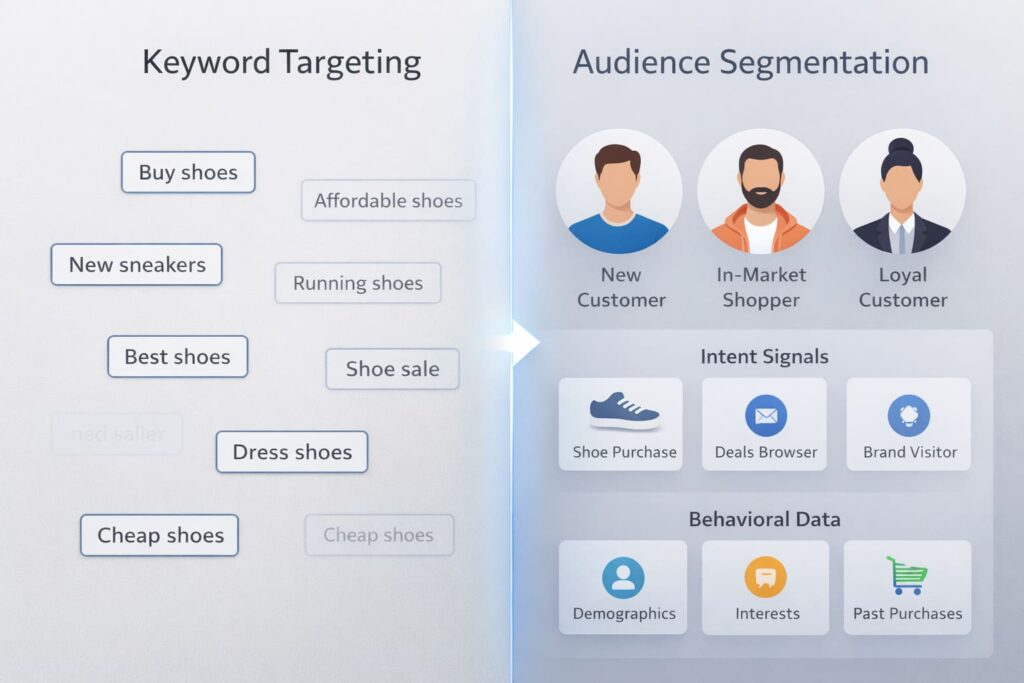
For years, PPC success was defined by keyword selection — finding the right terms to bid on and optimizing ad copy around those terms. While keywords remain important, today’s platforms (Google Ads, Microsoft Ads, Meta, LinkedIn, TikTok) offer powerful audience targeting capabilities that extend far beyond search queries.
Audience segmentation means grouping users based on shared attributes — demographics, behaviors, interests, intent signals, and more — so that ads can be delivered more efficiently to the right people at the right time.
This shift is driven by:
- Rising competition and increasing cost per click (CPC) across industries
- Privacy and data-protection changes (e.g., reduction of third-party cookies, ID closures)
- AI and automation features that rely on clean audience signals rather than broad targeting
- Greater demand for personalized experiences from users
Professional PPC managers understand that segmentation isn’t a nice-to-have — it’s a requirement for scalable performance.
2.What Is Audience Segmentation in PPC? A Deeper Look

At its core, audience segmentation is the process of dividing a broader audience into subsets of users who share common characteristics that influence their purchasing behavior.
Unlike simple targeting — “show ads to women aged 25–34 in Bangalore” — segmentation is about
strategic grouping informed by behavior and intent:
- Who has engaged with your brand before?
- Who has high-buying intent right now?
- Who resembles your best customers?
- Who is worth spending more budget on?
Segmentation organizes audiences so campaigns can:
- Allocate budget more efficiently
- Customize ad messaging and landing pages
- Improve bidding strategies by audience value
- Reduce wasted impressions and clicks
3.Why Audience Segmentation Matters More Than Ever in 2026

The digital advertising ecosystem has changed dramatically. Here’s why segmentation now matters more than ever:
3.1. CPC Inflation and Tighter Budgets
Across major platforms, CPCs continue to rise. Without targeted segmentation, ad spend can be wasted on low-intent traffic.
3.2.Privacy-First Environment
With restrictions on third-party data and identifiers, first-party and contextual signals are paramount. Segmentation helps make the most of reliable data.
3.3.AI and Automation Depend on Signals
Automated bidding (e.g., Google’s Smart Bidding, Meta’s Advantage+ Ads) performs best when fed meaningful audiences and conversion signals.
3.4.Personalization Is Expected
Users have grown accustomed to personalized experiences. Generic messaging results in lower engagement and higher costs.
Professional PPC management ensures that segmentation is not an afterthought, but a central pillar of strategy — continuously optimized over time.
4. Core Types of Audience Segmentation in PPC
 A robust segmentation strategy draws from multiple dimensions:
4.1 Demographic Segmentation
Grouping by age, gender, household income, location, education, etc., helps narrow the target population. But demographics alone are rarely enough — without behavioral context, they can lead to broad, inefficient targeting.
4.2 Behavioral Segmentation
Behavioral signals include website interactions, past purchases, content engagement, and time spent on site. These signals often indicate intent more accurately than demographics alone.
Examples:
- Viewed pricing page
- Added products to cart
- Watched product videos
- Frequent app usage
4.3 Psychographic Segmentation
This includes interests, lifestyles, values, and attitudes. Psychographics help tailor messaging that resonates emotionally, especially in awareness and consideration stages.
4.4 Intent-Based Segmentation
In PPC, intent is king. This is captured through:
- Search intent (keywords reflecting interest stage)
- In-market audiences (users actively researching products)
- Custom intent audiences (behavioral signals mapped to high-value keywords)
4.5 Firmographic Segmentation (for B2B)
In B2B PPC, audiences may be segmented by company size, industry, revenue, role, and buying authority. This is critical on platforms like LinkedIn and Microsoft Ads.
5. What Professional PPC Management Brings to the Table

While many advertisers attempt segmentation on their own, professional PPC managers elevate the process in these ways:
5.1.Strategic Data Analysis
Professionals don’t just create segments — they analyze data to find the most impactful ones and prioritize them.
5.2.Audience Layering
Combining multiple filters (e.g., intent + behavior + purchase history) to create nuanced segments, rather than relying on single criteria.
5.3.Customized Campaign Architecture
Instead of lumping all audiences into one campaign, pros build campaigns tailored to audience value and funnel stage, improving performance and control.
5.4.Continuous Testing
Segments evolve. Professionals A/B test audiences, creative, and bidding strategies to refine performance.
6.How Expert PPC Managers Build High-Performance Audience Segments

6.1 Data Collection & Integration
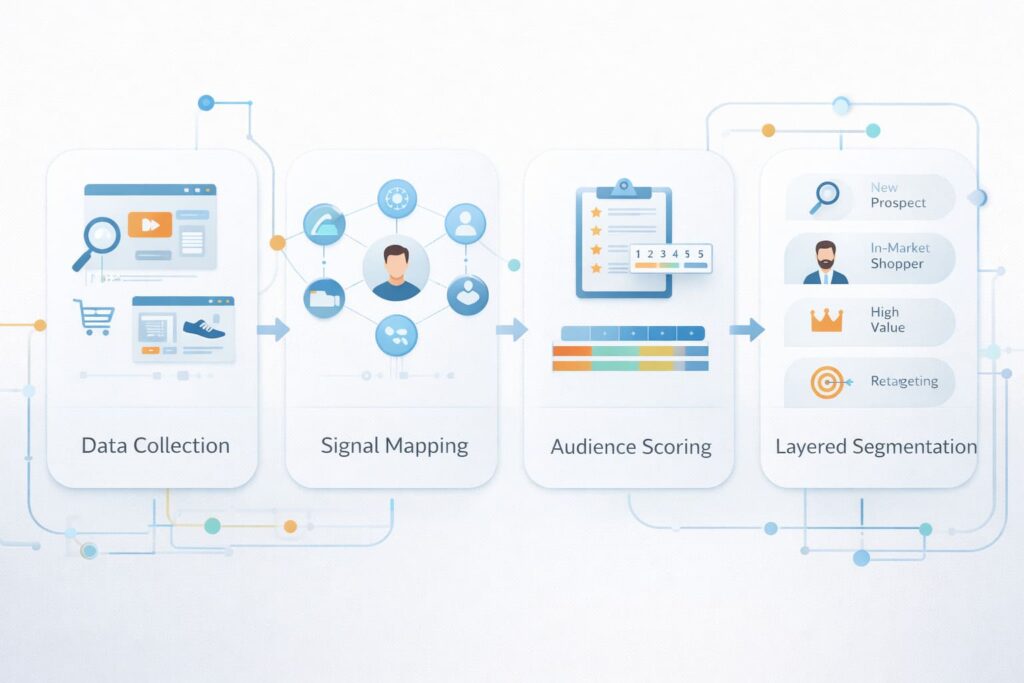
A professional PPC strategy often begins with clean data:
- Website analytics (GA4, server-side tagging)
- CRM & first-party behavioral data
- Platform insights (Google, Meta, LinkedIn)
Managers consolidate these signals to map user journeys and identify meaningful segments.
6.2 Signal Mapping and Scoring
Rather than assuming intent, pros assign scores to behaviors (e.g., high score for product views, medium for blog reads). This helps prioritize segments.
6.3 Audience Layering
Instead of broad all-users segments, managers create layered audiences:
- High intent: repeated product views + cart adds
- Mid intent: engaged content readers
- Cold: broad interest match + lookalike
This enables tailored bidding and messaging.
7. Segmenting by PPC Funnel Stage
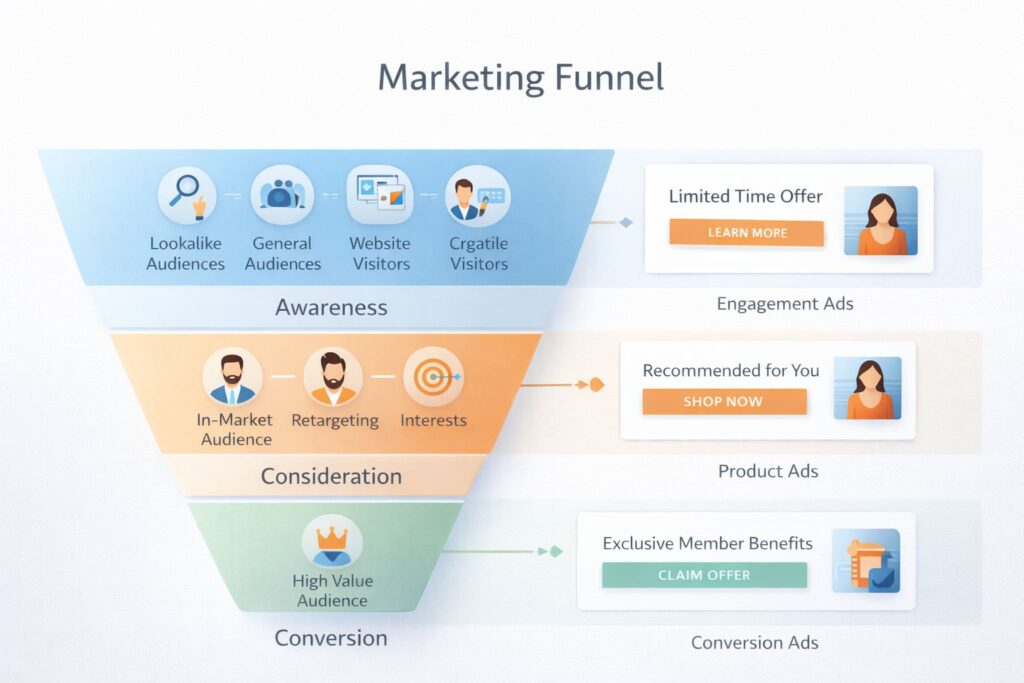
Audience segmentation must align with the user’s position in the funnel:
Top-of-Funnel (Awareness)
Objective: Introduce brand to relevant audiences.
Common segments:
- Broad interest groups
- Lookalike audiences based on best customers
- Demographic + psychographic combos
Messaging: Value proposition, why the brand matters.
Mid-Funnel (Consideration)
Objective: Build engagement.
Common segments:
- Users who visited multiple pages
- Video viewers
- Newsletter subscribers
Messaging: Benefits, social proof, differentiation.
Bottom-Funnel (Conversion)
Objective: Drive action.
Common segments:
- Cart abandoners
- Repeat visitors
- CRM lists
Messaging: Specific CTAs, offers, urgency.
8. Creative & Messaging Alignment: Turning Segments into Conversions
Segmentation without tailored messaging is like speaking loudly but not saying anything that matters.
Professional PPC teams align creative to audience nuances:
- Awareness ads emphasize brand values and emotional hooks
- Consideration ads highlight benefits and case studies
- Conversion ads leverage strong CTAs and incentives
Dynamic creative and landing page personalization further reinforce relevance.
9. How Segmentation Improves Key PPC Metrics
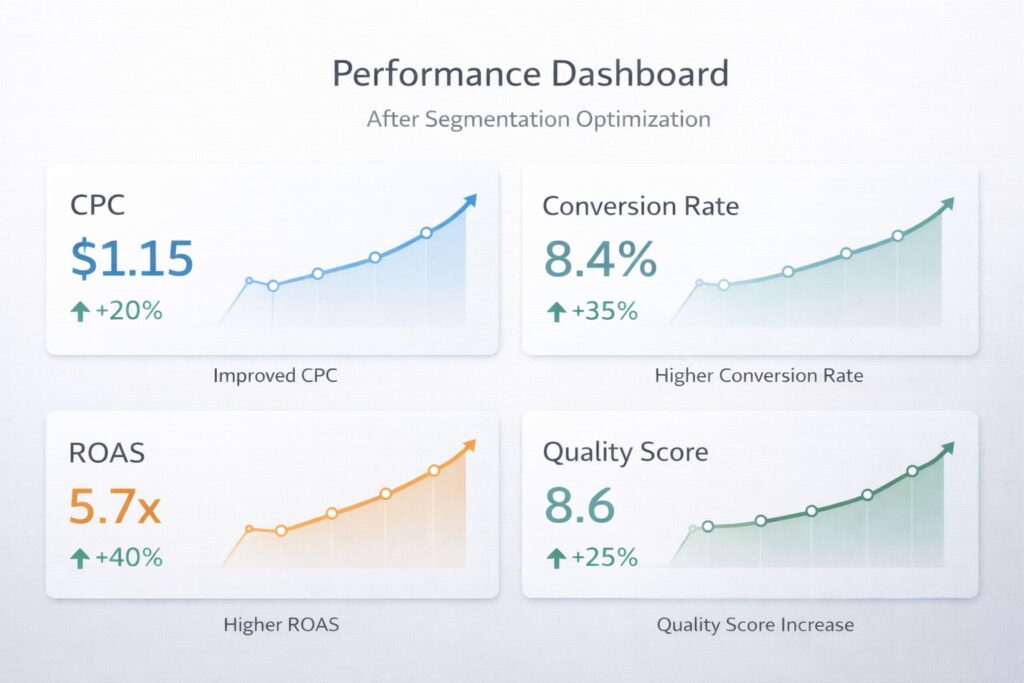
When segmentation is executed correctly, advertisers typically see:
9.1.Lower Cost Per Click (CPC)
Relevant audiences yield better engagement, which improves Quality Score and lowers CPC.
9.2.Higher Conversion Rates
Targeting users with known intent increases conversions.
9.3.Improved Ad Relevance & Quality Score
Segments with tailored messaging improve relevance scores, which in turn improve ad rank and reduce costs.
9.4.Reduced Wasted Spend
Non-performing segments can be excluded, and budgets shifted toward high-value groups.
10.Common Audience Segmentation Mistakes & How Pros Avoid Them
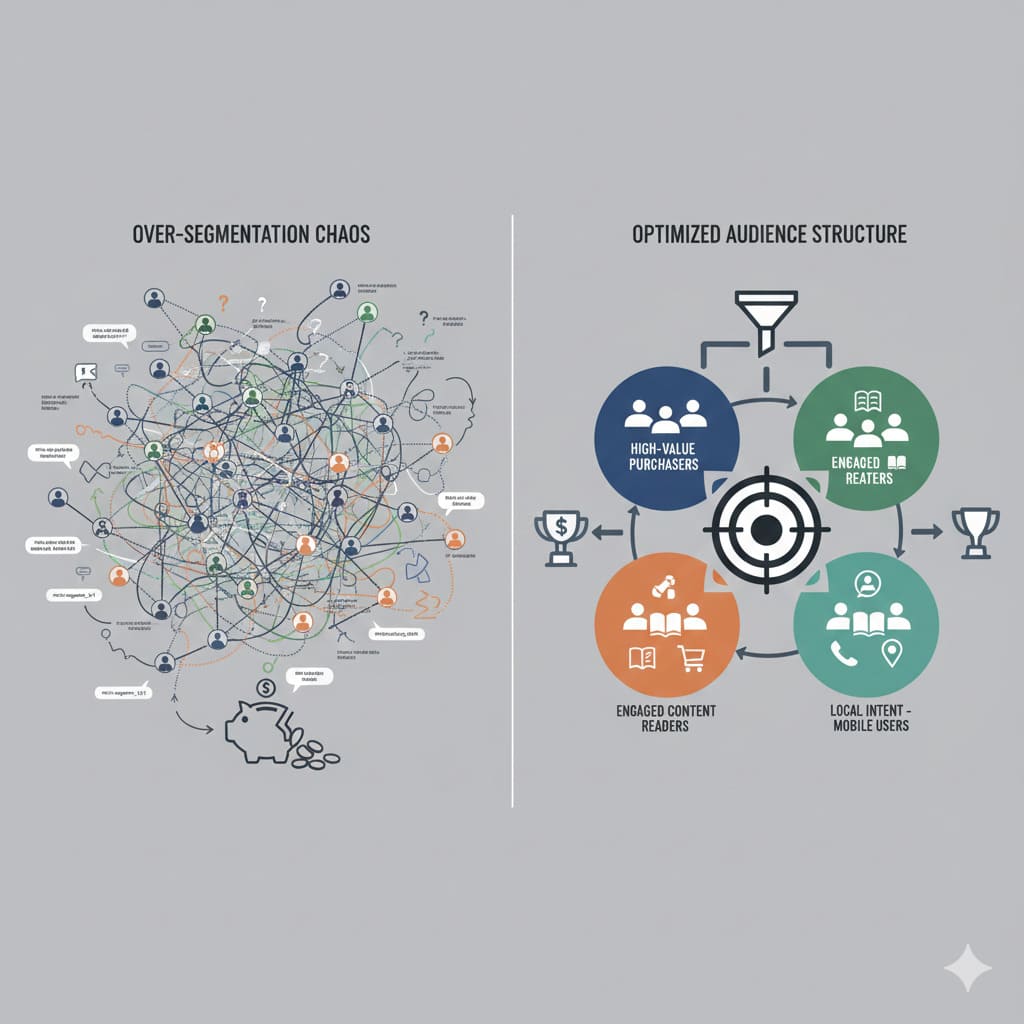
10.1.Over-Segmentation
Splitting audiences too thin leads to insufficient data for optimization.
Pro tip: Combine signals wisely and monitor data volume.
10.2. Ignoring Exclusions
Failing to exclude irrelevant audiences (e.g., past converters from awareness campaigns) wastes budget.
10.3. Relying on Defaults
Platforms suggest broad audiences, but defaults rarely align with unique business goals.
Professionals build custom segments based on internal data.
11. Measuring & Optimizing Audience Performance
Professionals rely on both segment-level KPIs and holistic measurement:
- Impressions & CTR by audience
- Conversion rate per segment
- CPA / ROAS by audience
- Contribution to assisted conversions
Optimization includes:
- Expanding high-performing segments
- Pausing low-performing ones
- Testing new signals and audience combos
Attribution modeling is critical — knowing which segments contributed meaningfully across touchpoints.
12. The Future of Audience Segmentation in PPC

As data environments evolve, professional PPC management will lean more on:
AI-Driven Audience Modeling
Predictive segmentation that anticipates intent before explicit signals.
First-Party Data Dominance
Brands that capture and structure their own data will outperform those relying solely on platform signals.
Privacy-First Contextual Targeting
Where explicit signals decrease, contextual and behavioral cues will gain importance.
Experts will blend automation with strategic audience design — not rely exclusively on black-box machine learning.
13. When to Invest in Professional PPC Management

Your organization should consider hiring professional PPC expertise when:
- You’ve maxed out basic segmentation and performance has plateaued
- CPC is rising faster than revenue growth
- You lack internal expertise to interpret audience data
- You want to scale paid acquisition profitably
A good PPC manager brings rigor, data discipline, and an iterative optimization mindset.
FAQ: Audience Segmentation & PPC
What’s the difference between audience targeting and audience segmentation?
Targeting is about showing ads to a group; segmentation is about organizing and prioritizing audiences based on meaningful signals like intent, behavior, and value to the business. Targeting can be broad; segmentation is strategic and data-driven.
How much segmentation is too much?
Too many micro-segments can dilute data, hinder optimization, and increase management complexity. A good rule: each segment should generate enough data to analyze and optimize. If a segment consistently shows low volume, consider merging it with a related group.
Are remarketing audiences considered segmentation?
Yes. Remarketing is a powerful form of segmentation because it stratifies users based on real engagement — such as page visits, time on site, cart activity, or app usage.
Which platforms support the most advanced audience segmentation?
Google Ads, Meta, LinkedIn, and Microsoft Ads all offer robust segmentation tools. However, the quality of segmentation often depends on the data sources you feed into the platform (e.g., first-party data, CRM lists, analytics integrations).
How do you measure the success of audience segmentation?
Key metrics include segmented conversion rates, cost per conversion, ROAS, engagement metrics (e.g., CTR), and contribution to multi-touch attribution paths. Compare segmented performance to baseline campaign averages to assess impact.
Can small businesses benefit from segmentation?
Absolutely. Even small budgets can see improved efficiency with basic segmentation — such as separating new visitors from returning visitors, or high-intent pages from low-intent.
Is audience segmentation relevant outside paid search?
Yes. While this guide focuses on PPC, segmentation is equally important in display, social ads, email marketing, and personalization strategies across channels.
How often should segments be reviewed or updated?
Segments should be reviewed regularly — ideally every 2–4 weeks early in a campaign, and monthly once stable. Changes in seasonality, product launches, or customer behavior may necessitate fresh segmentation.
Conclusion: Segmentation Is Strategy, Not a Feature
Audience segmentation is more than a checkbox in campaign settings — it’s a strategic discipline that, when executed with data, insight, and continuous refinement, powers sustainable PPC performance.
Professional PPC management doesn’t just select segments — it analyzes behavior, aligns creative, structures campaigns, and measures results to sharpen competitive edge and maximize return on ad spend. Trust today Pointteck, the best PPC Company In Ahmedabad. With customize PPC audience targeting strategies and data-driven insights, PointTeck ensure you ads reach the right audience for better result and maximum ROI