Pay-Per-Click (PPC) advertising is a performance-driven demand capture model in which advertisers pay only when a user triggers a predefined engagement event—most commonly a click. Unlike impression-based or reach-based media buying, PPC operates at the intersection of intent, relevance, and real-time bidding, making it one of the most capital-efficient acquisition channels available to small and mid-sized businesses.
For small businesses with constrained budgets, limited brand equity, and aggressive growth timelines, PPC functions as a controlled acquisition engine rather than a branding channel. It allows advertisers to intercept users at the precise moment of problem awareness or purchase intent, effectively compressing the sales cycle.
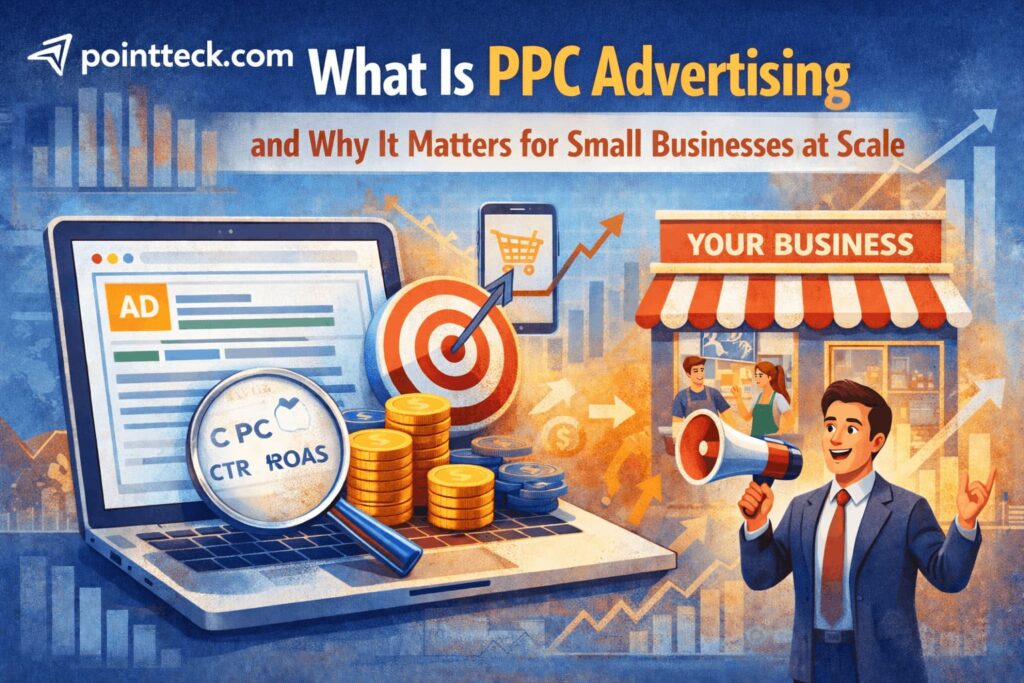
This guide explains PPC not at a surface level, but as a system—covering auction mechanics, intent modeling, Quality Score economics, conversion architecture, and optimization levers that determine profitability.
What Is PPC Advertising?
PPC advertising is an auction-based digital advertising model where advertisers bid on intent signals (keywords, audiences, placements), and platforms algorithmically determine ad eligibility, rank, and cost based on a combination of:
- Maximum bid
- Expected click-through rate (CTR)
- Ad relevance
- Landing page experience
- Contextual and behavioral signals
The defining characteristic of PPC is payment contingent on engagement, not exposure. This makes it fundamentally different from traditional media buying, where cost is incurred regardless of user response.
PPC Inventory Appears Across:
- Search engine results pages (SERPs)
- Display and native ad networks
- Video platforms (e.g., YouTube)
- Social media feeds (Meta, LinkedIn, X)
- Shopping and marketplace environments
For small businesses, Google Ads remains the most dominant PPC ecosystem due to high-intent search traffic, granular targeting, and mature conversion tracking infrastructure.
How PPC Works for Small Businesses
At an operational level, PPC is not “set and forget.” It is a feedback-driven optimization loop where intent signals, bidding logic, creative relevance, and post-click experience continuously interact.
1. Keyword Strategy and Search Intent Modeling
Keywords are not just triggers—they are expressions of intent. Expert-level PPC prioritizes commercial and transactional intent over volume.
High-performing small business campaigns focus on:
- Bottom-of-funnel (BoFU) keywords
- Long-tail and problem-specific queries
- Local modifiers and service qualifiers
Examples of high-intent searches:
- “24/7 emergency plumber near me”
- “book dental implant consultation [city]”
- “hire B2B SaaS PPC agency”
These queries indicate action readiness, not information gathering.
Advanced campaigns also incorporate:
- Match type sculpting (exact, phrase, broad with signals)
- Negative keyword frameworks
- Search term mining for incremental intent discovery
2. Real-Time Ad Auction Mechanics
Every eligible search triggers a real-time auction measured in milliseconds. Contrary to popular belief, the highest bidder does not automatically win.
Google evaluates:
- Max CPC bid
- Quality Score
- Expected impact of extensions
- Contextual factors (device, location, time, user behavior)
This allows smaller advertisers to outcompete larger brands through superior relevance and experience design.
3. Quality Score: The Economic Engine of PPC Efficiency
Quality Score is Google’s proxy for user satisfaction and is one of the most critical profitability levers in PPC.
A higher Quality Score results in:
- Lower effective CPC
- Higher ad rank at the same bid
- Greater impression share efficiency
Quality Score is driven by:
- Keyword-to-ad relevance
- Ad-to-landing-page alignment
- Historical engagement metrics
- Page speed, UX, and mobile performance
For small businesses, improving Quality Score often produces greater ROI gains than increasing budget.
4. Ad Creative: Message-Market Fit at Scale
Expert PPC ads are not generic promotions—they are problem-solving micro-messages designed to pre-qualify clicks.
High-performing ads:
- Mirror the user’s exact query language
- Surface a primary value proposition
- Reduce friction with clarity and trust signals
- Include a single, explicit call to action
Example:
Emergency Plumbing Services – Technician in 30 Minutes. Call Now.
The objective is not traffic volume, but conversion-ready traffic.
5. Landing Page Architecture and Conversion Design
Clicks have zero value without conversion. The landing page is where ROI is either realized or destroyed.
High-converting PPC landing pages are:
- Load-optimized (Core Web Vitals compliant)
- Mobile-first and thumb-friendly
- Focused on a single conversion action
- Message-matched to the keyword and ad
- Free of navigational leakage
Common conversion actions:
- Phone calls
- Appointment scheduling
- Lead form submissions
- Quote requests
- Direction or store visit tracking
Advanced setups also include:
- Call tracking
- Event-based conversion modeling
- CRM integration
- Offline conversion imports
6. Budget Control, Bidding Models, and Optimization
PPC provides deterministic budget control, which is rare in marketing.
Advertisers can:
- Set daily and monthly spend caps
- Pause or scale campaigns instantly
- Allocate budget by keyword, device, location, or audience
- Shift spend toward highest marginal ROI
With sufficient data, campaigns can transition from manual bidding to:
- Target CPA
- Target ROAS
- Value-based bidding
For small businesses, this enables predictable acquisition economics.
Strategic Benefits of PPC for Small Businesses
Demand Capture (Not Demand Creation)
PPC captures existing demand at the moment it manifests.
Immediate Market Entry
Campaigns can generate traffic within hours, not months.
Precision Targeting
Granular controls over:
- Geography
- Device type
- Time-of-day
- User intent stage
Full Attribution and Measurement
Every click, cost, and conversion is traceable.
Ideal for Local and Service Businesses
Particularly effective for:
- Local services
- Clinics and healthcare
- Home services
- Professional services
- B2B lead generation
PPC vs SEO: Strategic Role Comparison
| PPC | SEO |
| Immediate demand capture | Long-term demand creation |
| Paid placement | Organic authority |
| Budget-scalable | Time-intensive |
| High-intent keywords | Broad informational coverage |
| Predictable volume | Compounding growth |
Optimal strategy:
Use PPC to generate immediate revenue and data, then use SEO to reduce long-term acquisition costs.
How Much Does PPC Cost?
PPC has no fixed price—cost is a function of competition, intent, and efficiency.
Cost drivers include:
- Industry competitiveness
- Keyword commercial value
- Geographic density
- Quality Score and conversion rate
Typical starting budgets:
- ₹10,000–₹50,000/month (India)
- $500–$3,000/month (global SMB average)
What matters is not CPC, but cost per acquisition (CPA) and lifetime value (LTV) alignment.
Is PPC Worth It for Small Businesses?
Yes—when engineered correctly.
PPC succeeds when:
- Keywords are tightly segmented
- Ads map directly to intent
- Conversion tracking is accurate
- Landing pages are optimized
- Decisions are data-driven, not emotional
Under these conditions, PPC becomes a repeatable revenue channel, not an expense.
How to Start PPC the Right Way (Expert Framework)
- Define a single primary conversion goal
- Start with Google Search campaigns
- Target high-intent, low-waste keywords
- Set conservative daily budgets
- Implement conversion tracking from day one
- Optimize weekly based on CPA and conversion quality
Frequently Asked Questions
Q. What is PPC advertising in simple terms?
A. PPC is an online advertising model where businesses pay only when a user clicks their ad, allowing precise targeting of high-intent audiences.
Q. How does PPC help small businesses compete?
A. Search platforms prioritize relevance and user experience, not budget size. Well-optimized campaigns can outperform larger advertisers.
Q. Is PPC suitable for limited budgets?
A. Yes. Spending caps and intent targeting allow small budgets to generate measurable returns.
Q. How fast does PPC generate results?
A. Campaigns can begin driving traffic and leads within hours of activation.
Q. What’s the biggest mistake in PPC?
A. Targeting broad keywords without intent filtering and failing to track conversions.
Final Thoughts: PPC as a Growth System, Not Just Ads
PPC is not merely about buying clicks—it is about engineering visibility at the exact moment of intent.
For small businesses, PPC provides:
- Speed: Immediate access to demand
- Precision: Budget spent only on real buyers
- Scalability: Growth without exponential risk
- Transparency: Clear attribution and ROI
When executed with technical discipline and strategic intent, PPC becomes one of the most powerful and controllable growth levers available—allowing small businesses to compete, scale, and win in highly competitive markets.